
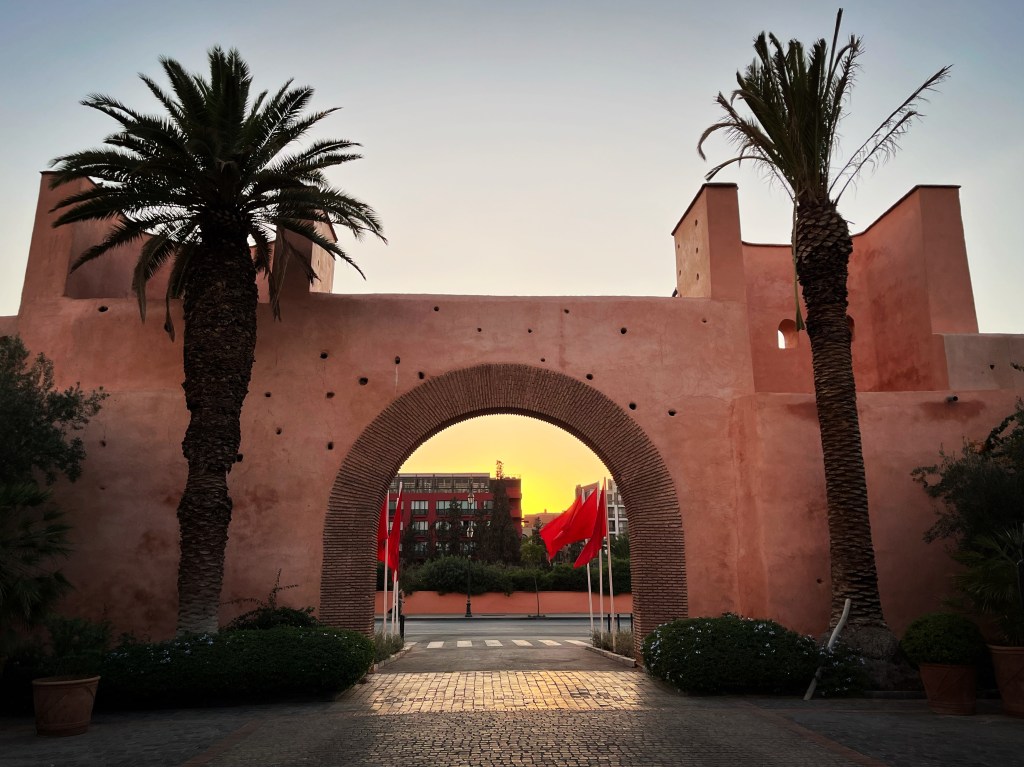
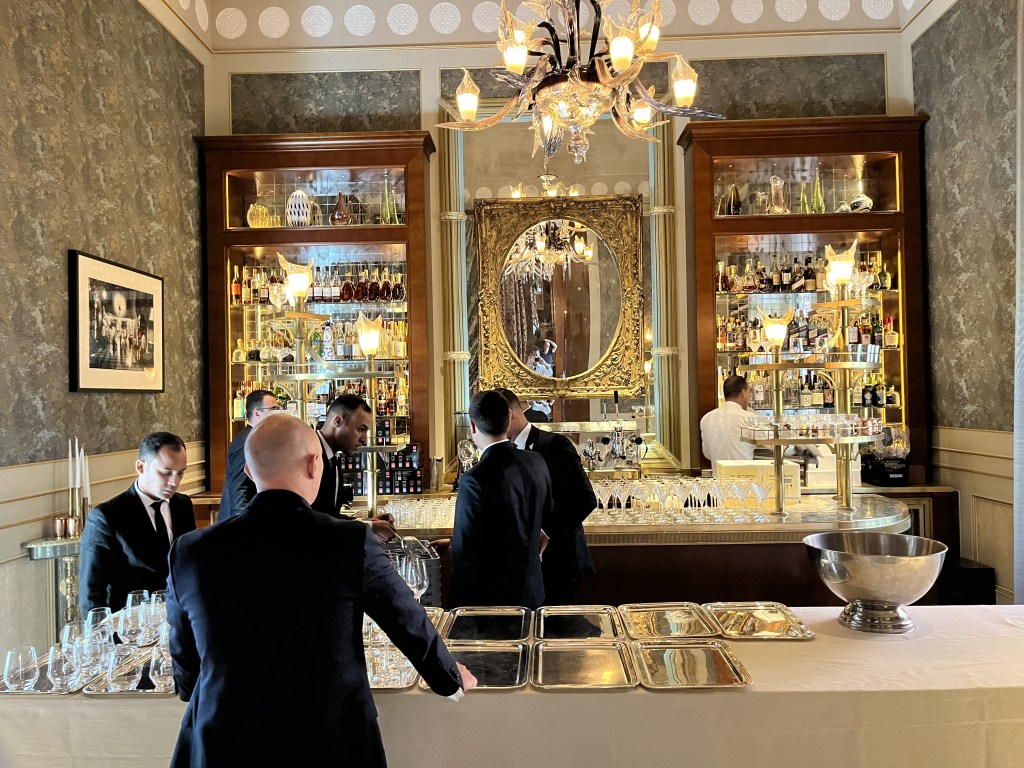
My mission was in Marrakesh: five days at the Royal Mansur as culinary intermediary for the kind of Indian wedding that’s photographed for the New York Times. Five days of celebration. Five days of total, saturnalian annihilation. This wedding had it all. A sangeet and baraat. A haldi and mehendi. Even an ultra-formal, western-style dinner following the ceremony. Five days of consecutive buyouts at one of Morocco’s most exclusive hotels and resorts, where each guest, all 200 of them, was an invited participant in one of the most lavish weddings the Royal Mansur had ever seen.
Millions of dollars were being spent, all in the name of fun.
I was in Morocco to make sure it all went off without a hitch. My job: make sure the kitchens of the Royal Mansur were producing food for these events exactly as the wedding couple wanted it produced, precisely at the time of day (or night) they wanted it served. It was an arduous task, this work I was being asked to do as an English-speaking monoglot in an Arabic-speaking kitchen, one governed by the strictest of French rule. The work was bad enough to seem almost Sisyphean in its toil. At the end of every bruising, fifteen-hour day, awaited another day just like it, full of the selfsame agonies, knife wounds, and oven burns.
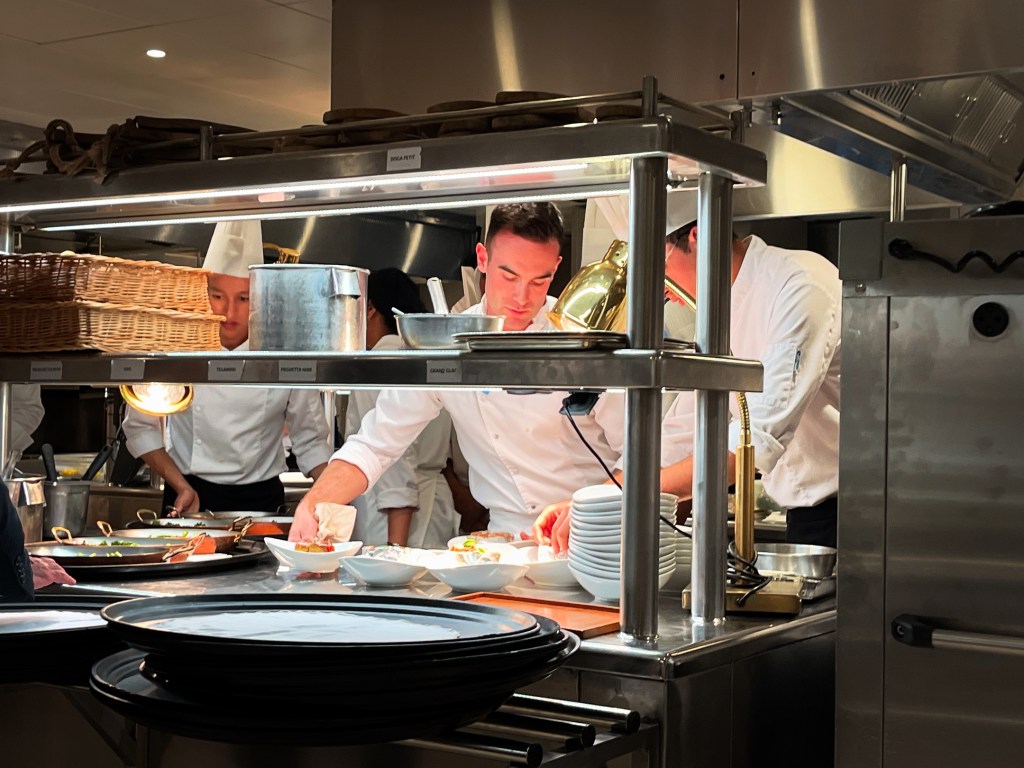
Adding insult to injury: the Royal Mansur’s executive chef hated me on sight. He spoke only French, only when it pleased him, and only, apparently, to vent the wine-soaked invective from his Gallic spleen. And who could blame him. I was this American, this culinarian of dubious pedigree, who’d traveled half-way across the world to oversee his brigade in his kitchen. This indignity he would not, could not abide. And he resolved to make my time at the Royal Mansur as unpleasant as he could. Prep tables were pounded. Pots were thrown. Insults were exchanged across the pass like rounds of rapid-fire ammunition.
C’est normal.
Because at the end of our time together, we were close as blood brothers, laughing, hugging, slapping each other on the back with the kind of fraternal affection that only five days of hand-to-hand combat can produce.
By any measure, the wedding at the Royal Mansur was a resounding success. The wedding couple were beyond happy, and my client was over the moon. How happy? She hired a private tour guide to show me around Marrakesh on my one day off. A day seeing the sights of Marrakesh in recompense for a job well done.

I met my guide in the lobby of Sofitel and with him rode to Souk Semmarine, Marrakesh’s most famous market, a shadowy network of smoke-choked backstreets and alleyways, where local merchants peddle wares to travelers like me. My guide was affable enough. He was native to Marrakesh, quite tall, in his early 60s, and smelled strongly of hashish. He wore the pony-tail and shark-skinned suit of an aging hipster intent on still making the scene, and his knowledge of all-things-Marrakesh was encyclopedic. He knew absolutely everything about the city. Which rooftop offered the best views of the city. Which merchants offered the finest, hand-woven rugs. Knowledgeable as he was, though, I wanted nothing to do with the guy. Five days of contumelious toil inside the Royal Mansur’s kitchen had killed all conviviality in me; it had deadened all need for fellowship or conversation. I wanted to be by myself. I wanted to be left to wander the city, alone.
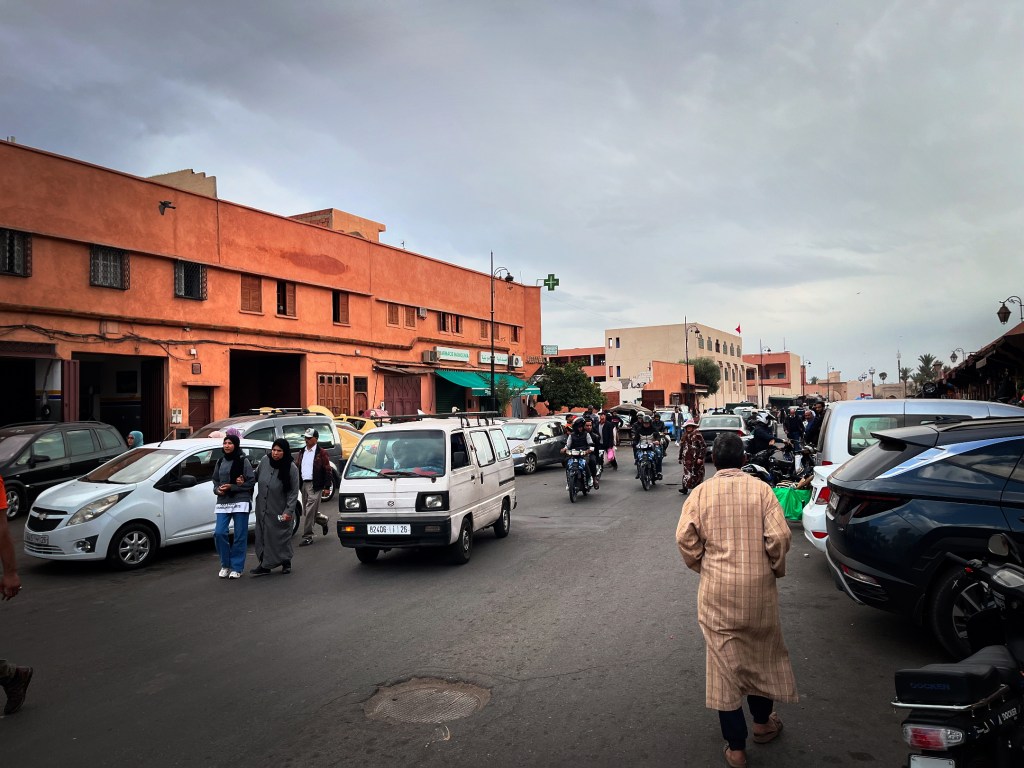
And that’s what I did. I ditched my guide with a jaunty wave of adios and took off on my own. I wandered south, then west, though streets choked with traffic and teeming with throngs of people speaking a language I didn’t understand. I took no map, nor did I glance at my phone. I had no idea where I was going. I walked, first this way, and then that, going deeper and deeper into Marrakesh on roads chosen entirely at random until I had lost all sense of direction, until I had absolutely no idea where I was.
I was lost, and that’s precisely where I wanted to be.

And then something caught my eye: grill smoke floating above a waiting line of taxi cabs. This was the convergence of two things—hungry drivers and available food—that inevitably portends that good stuff is being offered, and cheaply, just up ahead. I investigated. I was right. For there, mid-block, on Marrakesh’s Rue Ibn Rachid, stood the miraculous Restaurant Imaj.
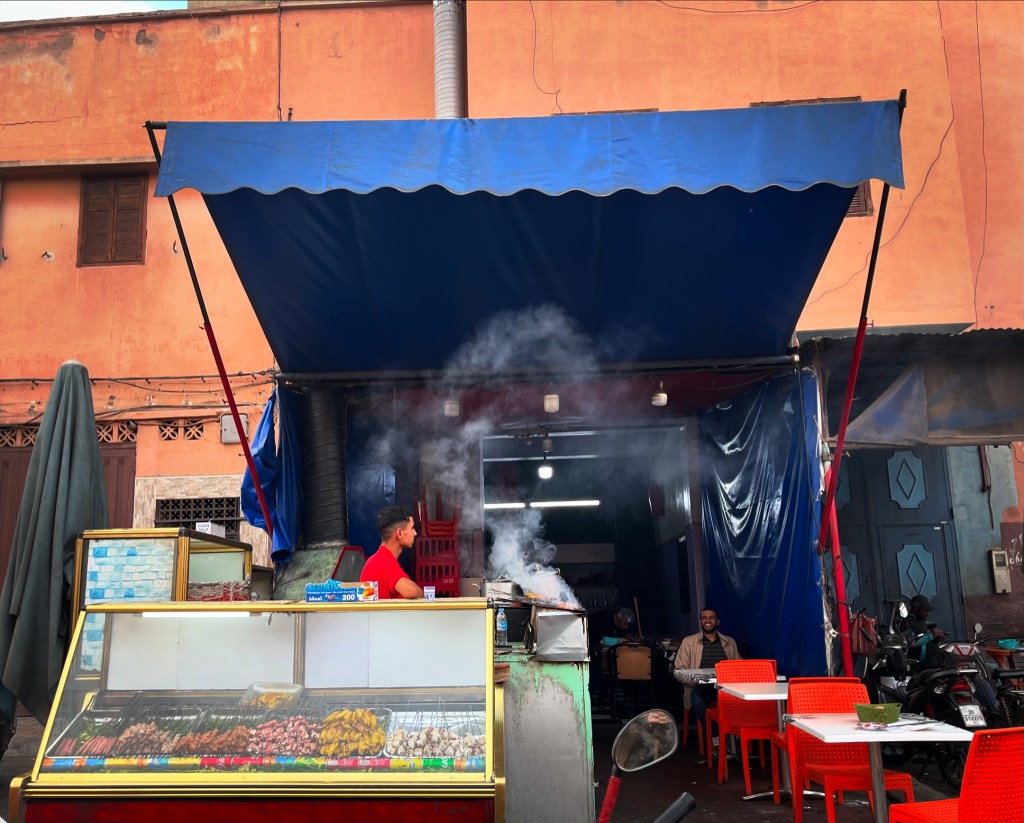
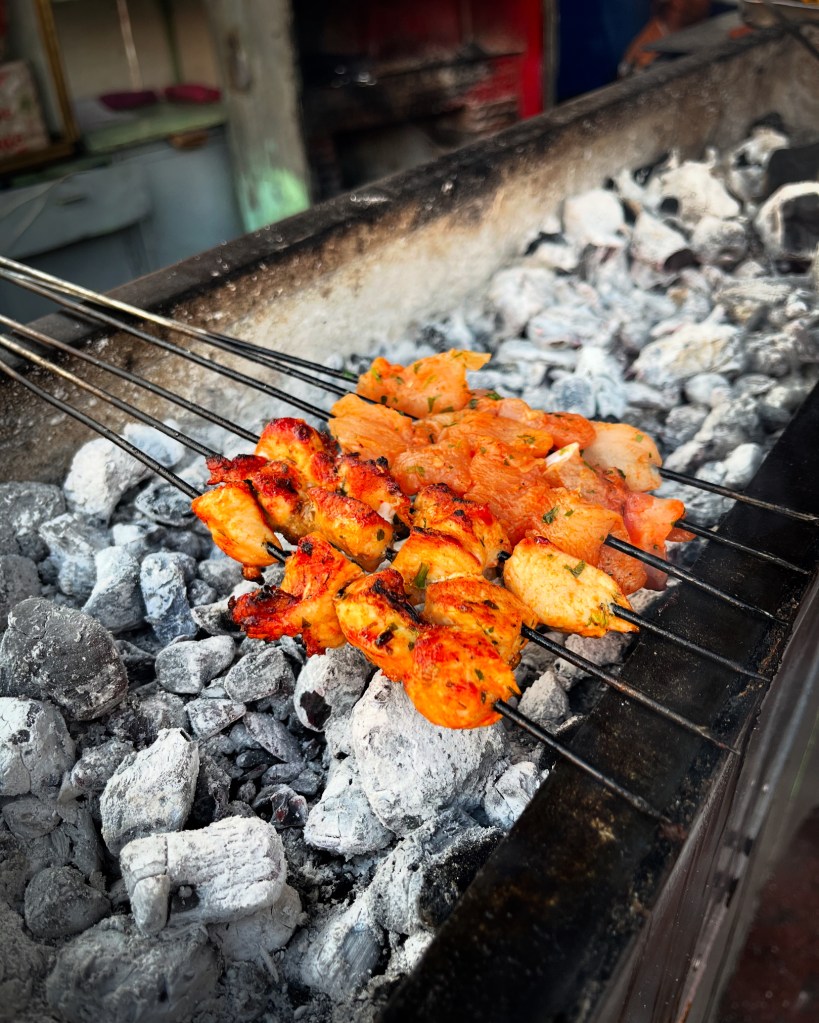
More open-air eatery than traditional, western-style restaurant, Restaurant Imaj operates as a kind of roadside canteen, where meat from various animals—chicken, lamb, and what appeared to be offal of some kind—is skewered on metal and cooked over charcoal for a coterie of cab drivers ravenous for something unctuous and filling. For travelers like me, who speak no Arabic, methods for procurement at Restaurant Imaj are simple: approach the glass butcher’s case and point to the animal protein you’d like to eat. With that same hand—your right—you then indicate the desired number of skewers. For my lunch of grilled chicken, I order three skewers, then sit on a plastic chair, at a plastic table, downwind from Restaurant Imaj’s tiny, counter-top grill, and bathe in the billows of wood smoke that my cooking lunch blows my way.
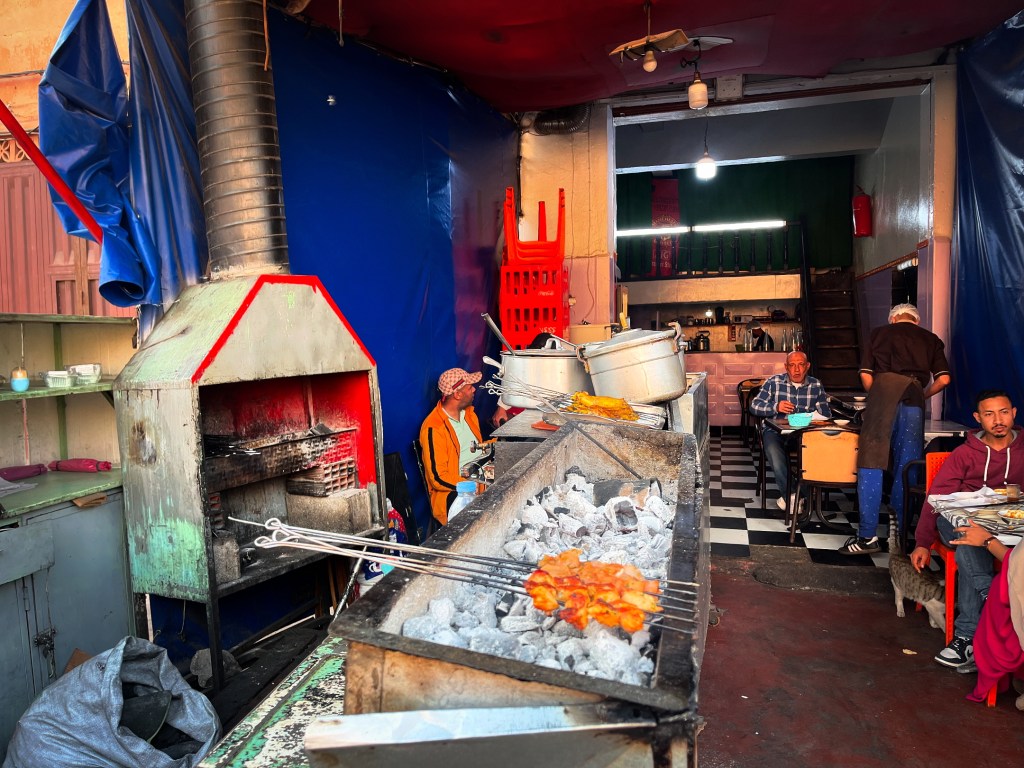
I wait. And then it happens. The moment every traveler like me dreams about. The moment you disappear from the world you’ve always known by passing through some door, some magical meridian, and come out, on the other side, forever changed. This moment happens to me, here in Marrakesh, on the city sidewalk, seated at a table, waiting for lunch. The moment when absolutely nothing around me is familiar. Not the sounds the cars and passing motorbikes make. Not the language being spoken. Not even the music of songbirds. It’s in this moment that I pass from the world I’ve known and enter another, one into which I’m born, anew. It’s a moment of epiphany. A moment of revelation. And here it is, delivered to a sidewalk, in wood smoke, as cab local drivers look on, watching this magical thing happen to me, wearing, as they all are, attitudes of confederacy and wonder. It’s an astonishing thing to experience, this moment of awakening at the nexus of being and nothingness. If it’s ever happened to you, then you know what I’m talking about.

My food soon arrives, delivered by a friend of the cook, who seems to be volunteering as restaurant’s lone, ad hoc waiter. Three skewers of grilled chicken accompanied by khobz, a Moroccan bread, and matboukha, a kind of Moroccan salsa notable for its paprika. And nothing to drink. An austere meal, to be sure, but one whose simplicity focuses one’s attention on its elements, few as they are: animal flesh suffused with woodsmoke; the umami-rich slurry of tomato; the saltless bread there to bolster satiety. All for 20 Moroccan dirham, or $2 USD. It’s an astonishing plate of food for that price, this meal I’m given.
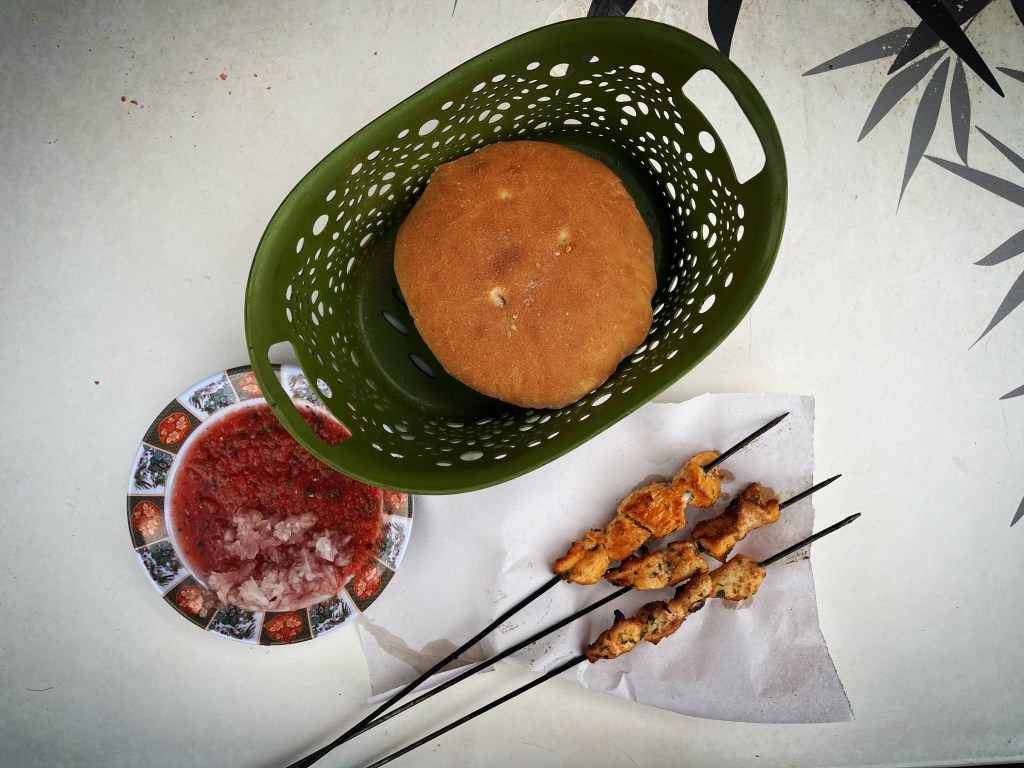
But I’m given no flatware, and so I eat with my hands. I remove chicken from the skewers with my teeth. I go at the matboukha with the khobz like a child at a game of whac-a-mole, punishing the poor condiment with what I’m sure are angry-looking passes of bread. To watch me eat is to take me for an escaped prisoner, perhaps. It’s certainly to wonder why a westerner like me—the kind who so violently devours his food—has been loosed upon the nice people of Morocco. That’s how good the food of Restaurant Imaj is, that it compels me to make a public spectacle of myself as I eat. It’s one of the best meals of my recent, adult life. This food, simple as it is, is astonishing to behold.
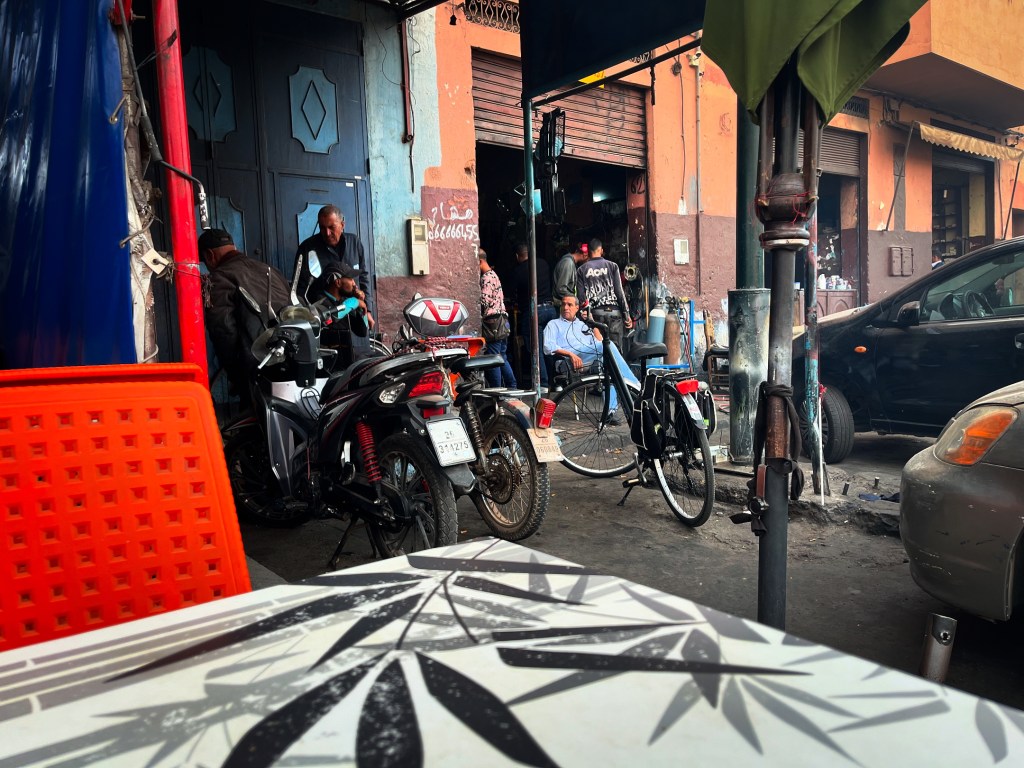
What, then, am I to make of this, this epiphany found in a plate of food, next to a cab stand, in the middle of mid-day Marrakesh? What’s the take away here? It’s really quite simple, I suppose. I’m being taught that as a traveler, I’m supposed to wander through every city I visit. That I’m supposed to stray, unattended, without guidance or map, across this great, wide world. And that in traveling, I’m supposed to get lost, and that through waywardness, I might discover the place I’m in, as it really is.
Lesson learned.
And I can’t wait to meet you there, on the other side.
See you in Morocco. See you at the Restaurant Imaj.
Contact: christopher@proletariateats.com
 Propaganda by Proletariateats
Leave a comment