
Think of Seattle and tell me what comes to mind. Is it the city’s dimly-lit coffee houses of yore—like the very first Starbucks in Pike Place Market—that you’re thinking of? Is it the Space Needle? Or perhaps you’re subsumed with the vestigial miasma of that once-mighty, grunge-rock scene—that particular scent now filling your head—with a pure and pungent synesthesia from its most famous, patchouli-wearing, flannel-shirted practitioners like Soundgarden, Pearl Jam, or Nirvana.
Whatever comes to mind when imagining Seattle, I’m guessing that a Thai restaurant is nowhere on your list. Which is perfectly understandable, given ocean-adjacent Seattle’s well-deserved reputation as a veritable Mecca for fruits de la mer. But by not listing Thai food among Seattle’s greatest contributions to contemporary American culture, you’re making a major blunder, my friend; a mighty, mighty mistake. That’s because Seattle not-so-secretly boasts one of the best, most imaginative—and dare I say authentic—Thai restaurants in North America, a must-have culinary experience for visitors to the Emerald City ravenous for south-Asian street food and hungry for the real fucking deal.
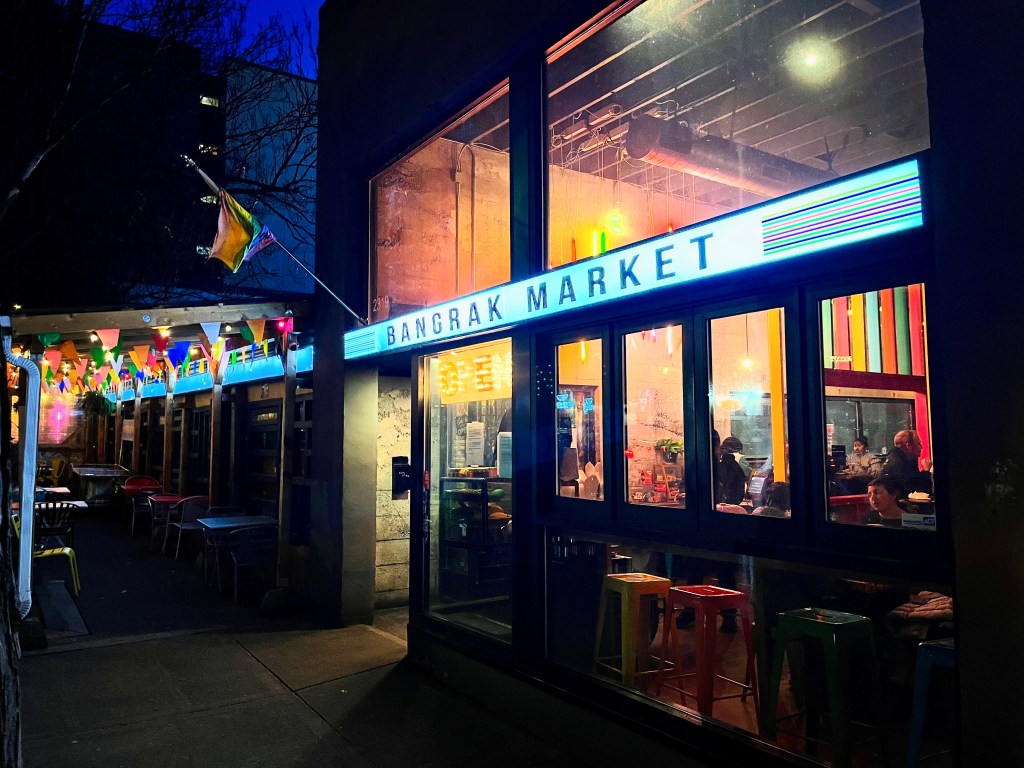
Behold Bangrak Market. Established in 2019 by SangDuen Auesiriwong and Ott Jaicharoensook in Seattle’s Belltown neighborhood, Bangrak Market recalls the night-markets of Bangkok, where all manner of ferocious deliciousness can be found, in myriad form, no matter the lateness of the hour, no matter the inebriation levels of your fellow eaters or cooks. The same might be said for Bangrak Market. Outside, it’s a regular-looking Seattle restaurant. Just your everyday joint serving up delicious fare on an all-American street.

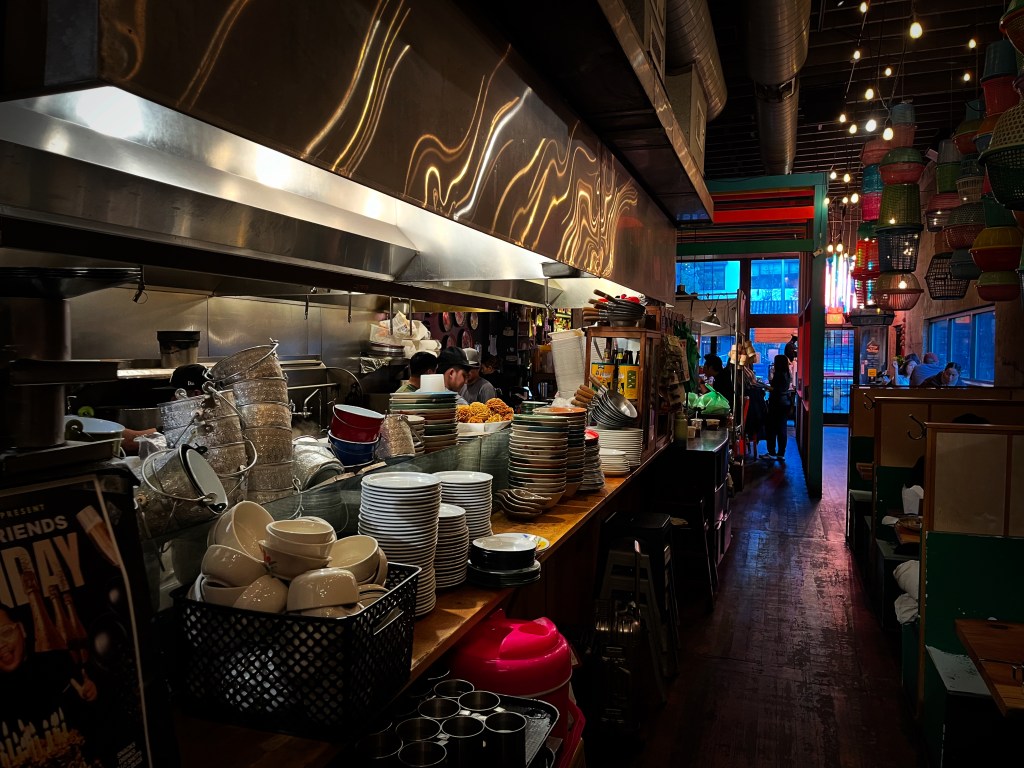
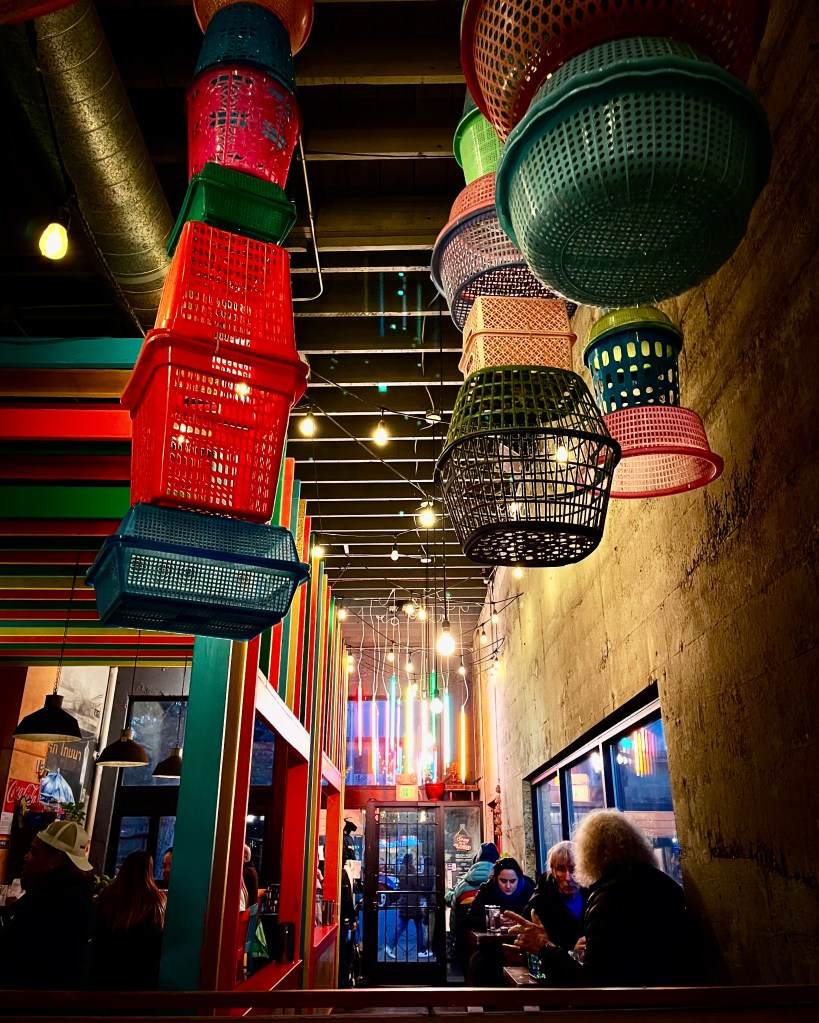
Step inside, however, and you’ll discover Seattle’s Bangrak Market is modeled after Thailand’s famous Chatuchak Market, with its loud, turned-up-to-11 techno soundtrack and its frenetic, anything-goes, late-night, street-fair vibes. Step inside Bangrak Market, and you’ll know by the smell—and by all that culinary heat coming off the line—that the culinarians here aren’t fucking about. They’re serious people doing seriously amazing things with Thai food. To cross Bangrak Market’s threshold is to breach a magical, culinary meridian; it’s to pass into a gastronomic dragon’s den of fire-breathing delights.
Enter and be amazed.
We came to the restaurant early, on a recent Monday afternoon, my wife and I, fresh off a pleasure trip to British Columbia, where we’d eaten Canadian salmon at nearly every meal. Delicious, of course, but maybe too much of a good thing, if you know what I mean. Now, on the day of our visit to Bangrak Market, we’d reached the point of real need, requiring massive, main-line infusions of incendiary, south-Asian spice to offset all that magical Canadian sublimity. We needed dietary heat. And we needed it bad. Like the moon needs the sun. Like a needle needs a spoon. We were spice junkies looking for a fix.
Enter Bangrak Market. Amen for that.
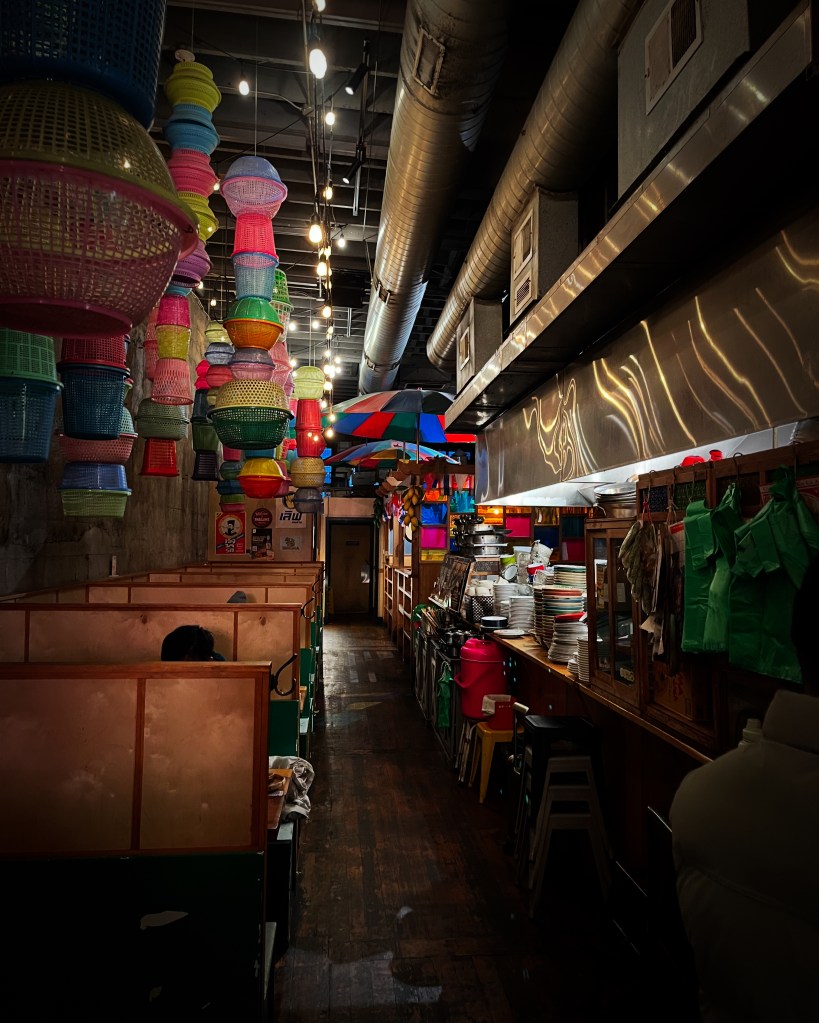
We were seated at a table, small and tall, at the forepart of the space, near the restaurant’s front door. Our server greeted us, and she couldn’t have been any more lovely. But once we’d ordered our meal—five dishes in all, plus drinks—our table was suddenly declared “way-too-tiny-for-food,” and we were ushered to a much larger eating space, the last in a long line of banquettes, deep inside the bowels of Bangrak Market, back where the music was now tooth-rattlingly loud, and where there was almost no ambient light, save what was coming off the line, from woks, in great, and successive bursts of sesame oil-fueled fire. It was as if my wife and I had suddenly been teleported to some back alleyway in Bangkok, or tipped into the belly of some fire-breathing whale.
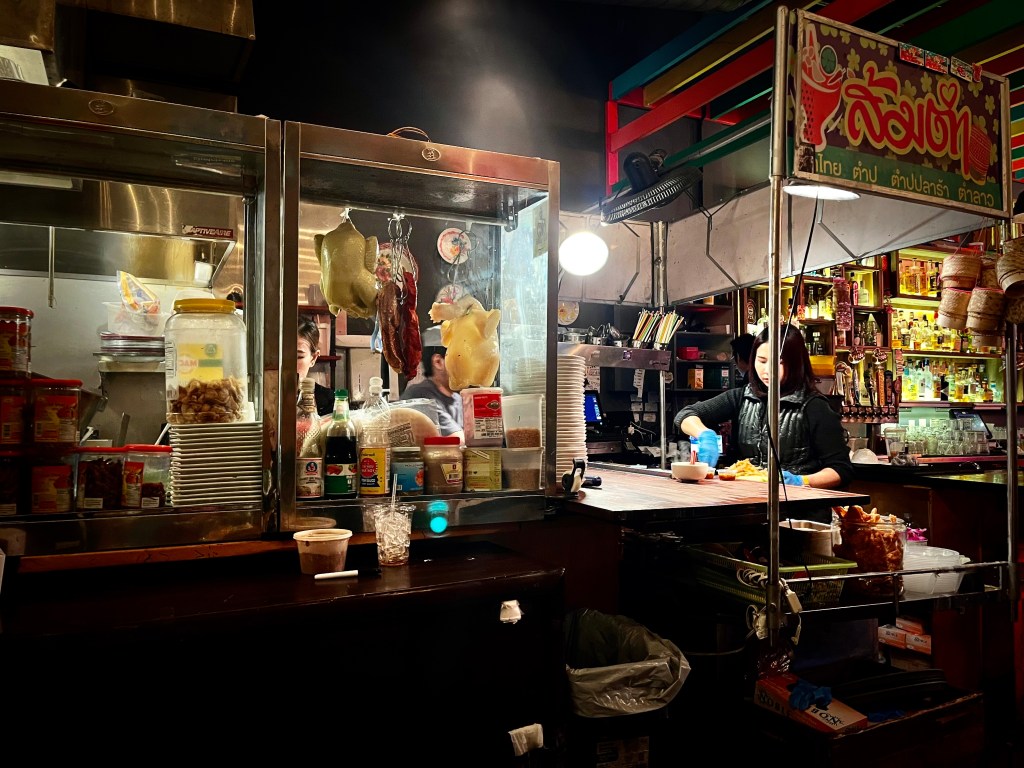
We couldn’t have been more pleased.
Then came the food. One dish after another—boom, boom, boom—delivered in rapid succession, by a swarm of servers, like punches thrown from a throng of Thai boxers. Within seconds, our table was piled high with platters and bowls. My wife looked at me and laughed. We ogled each other, wide-eyed with incredulity, in genuine awe, and then took up our chopsticks and began to eat.
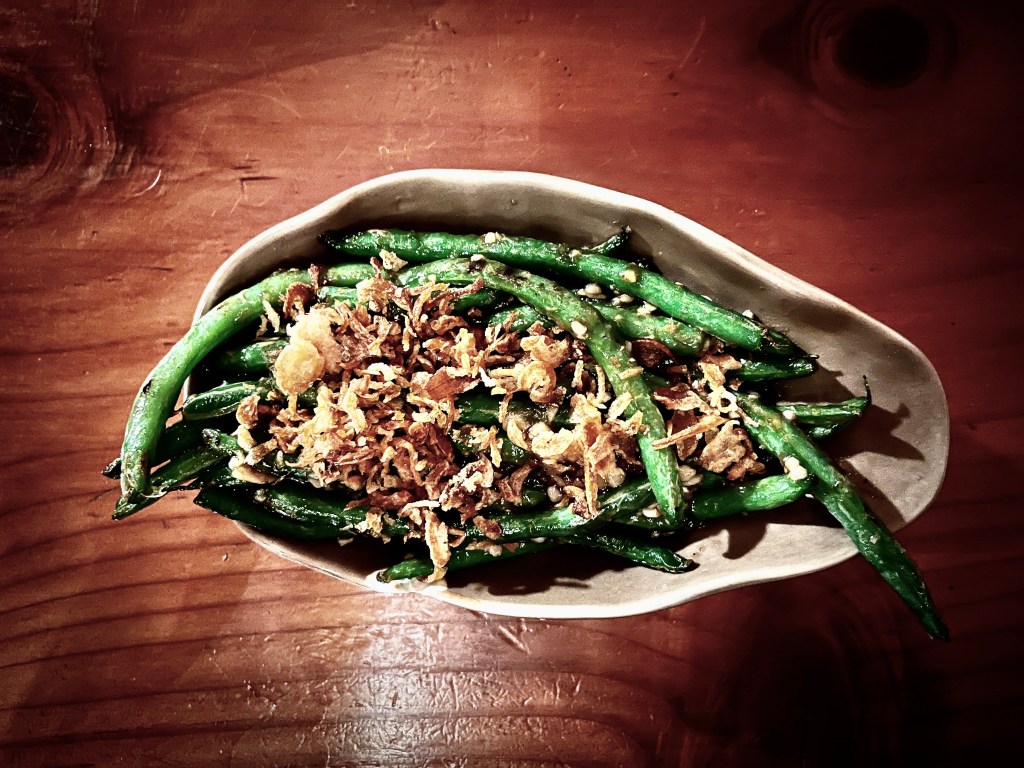
We started with green beans. That’s exactly how they’re listed the menu—green beans—with no more hot-hot-sexy-hot descriptors than that. And while they were indeed beans, yes, and while those beans were indeed green, the banality of the nomenclature by which they were described on the menu entirely betrayed the motherfucking brilliance of the dish: beans that more resembled candy, not for their sweetness—though, of course, there was a hint of that—but for the way one’s appetite for the dish grows on which it’s fed, to lift a phrase from Shakespeare. Superb beans. Beans cooked to a perfect toothiness, and seasoned with an absolute balance of sugar and heat. They were some of the best green beans I’ve ever eaten. Like, in my life. These beans, dude. I’m telling you.
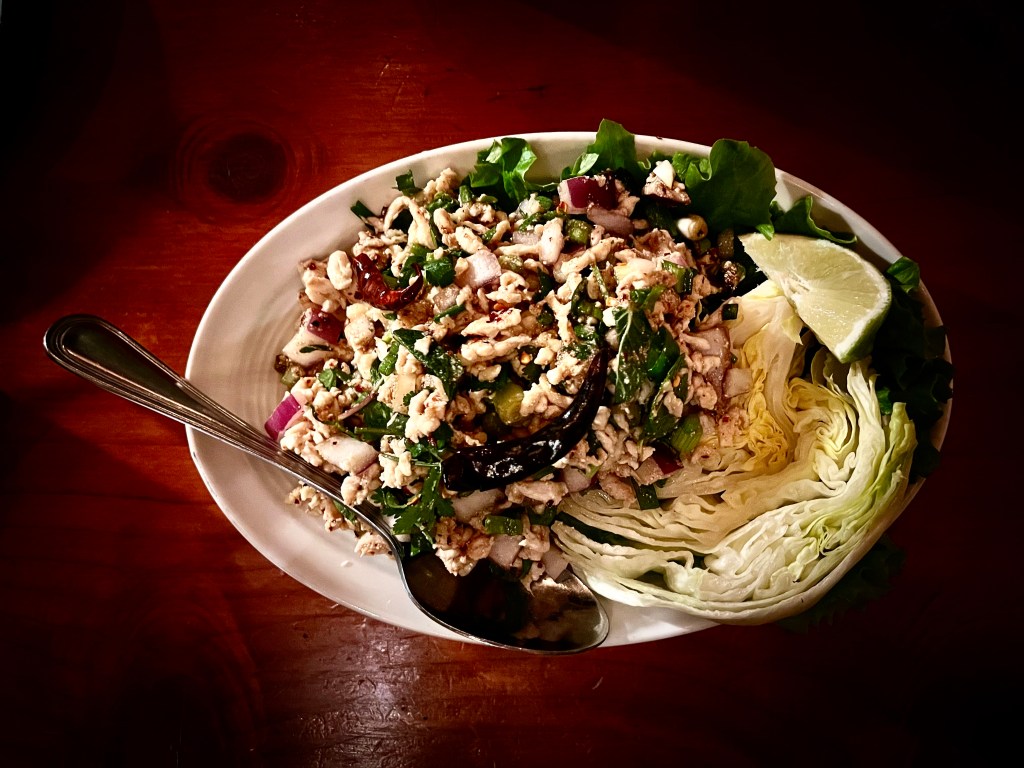
Next, we moved on to the larb: ground chicken, aggressively spiced with hot peppers and red onions, and then seasoned with lime juice and fish sauce. This was mixed with rice and lavished atop a cooling bed of iceberg lettuce. Larb might be the national dish of Laos, but the Thai cooks of Bangrak Market have mastered the dish, completely and utterly. To have Bangrak Market prepare larb was to position the dish, and perfectly, at the confluence of where the four rivers of Thai flavors converge and dance: that intersection of salty and sour and hot and sweet. Bangrak Market’s larb is magnificence on a plate.
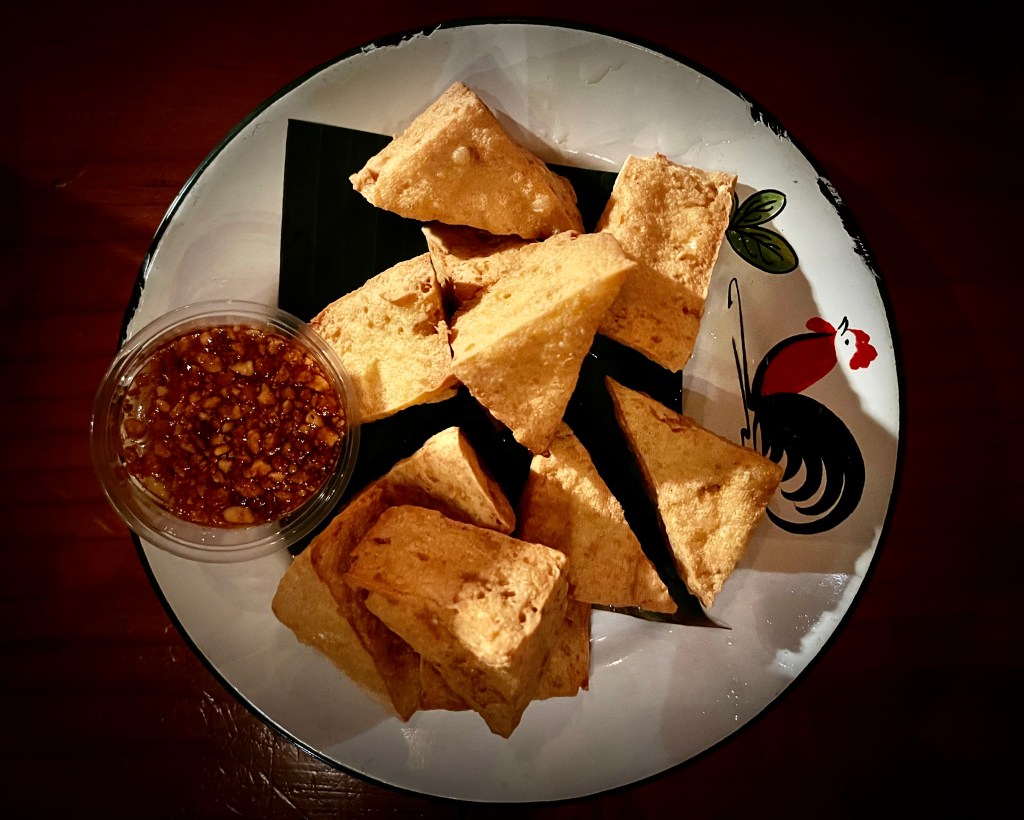
Then came the tofu. Yeah, yeah. I know what you’re thinking: tofu sucks. It’s the obligatory red-headed stepchild of Asian cuisine, the one thing culinary knuckle-draggers and rubes order in Thai restaurants when they’ve no idea what else to get. And yes, I’d admit that restaurant tofu is often a poor choice. But not the tofu of Bangrak Market. This stuff is pure yumminess, man: pan-seared in a way that produces something akin to a burnt-sugar crust on the outside, the kind you find seated atop crème brulee, while the tofu’s interior remains as soft and pillowy as a cloud.

For our penultimate dish, we had the massamun curry. It’s mildly spiced and nutty; a deeply unctuous curry. It boasts tofu, potato, onion, carrot, and, yes, peanuts, all served in the kind of silver chalice that appears in Arthurian legend, passed among Knights of the Round Table. Once considered the gastronomic bastard child of a Persian, Indian, and Malay menage a trois, Thai cooks have now adopted massamun curry as one of their own; they’ve empowered it, emboldened it, even, to walk shoulder-to-shoulder among its culinary brethren—archetypal Thai dishes like tom zap, like yum woonsen—with its chin held high, its chest out and proud.
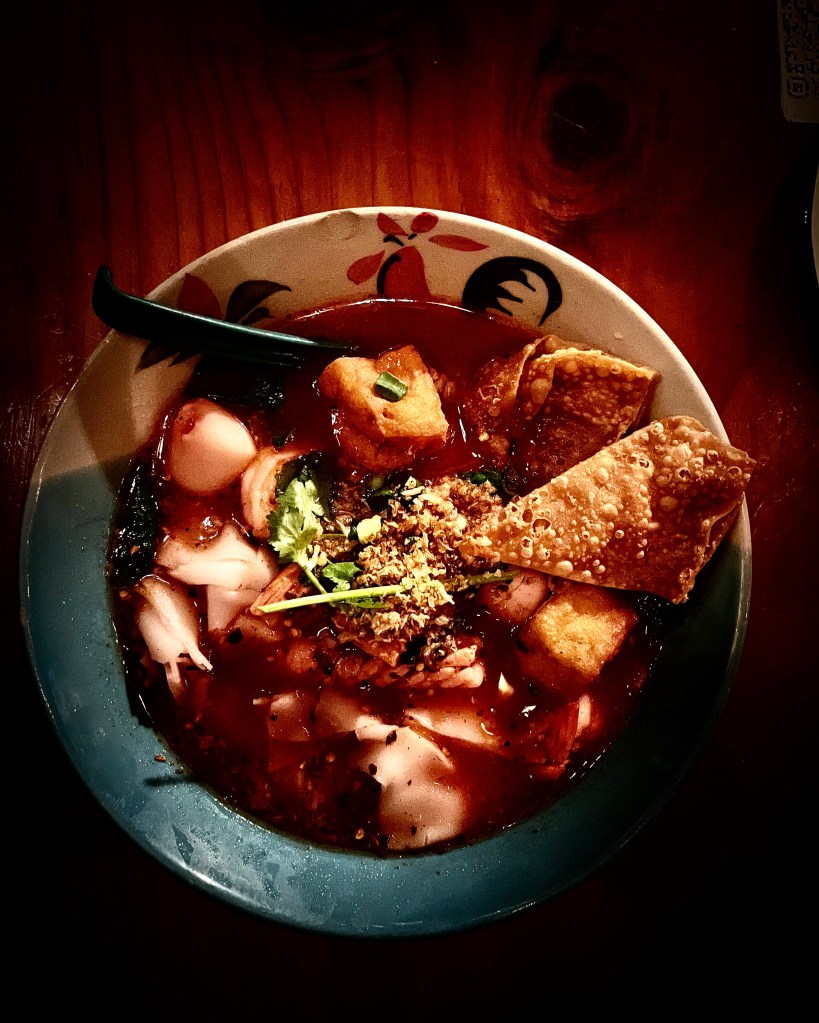
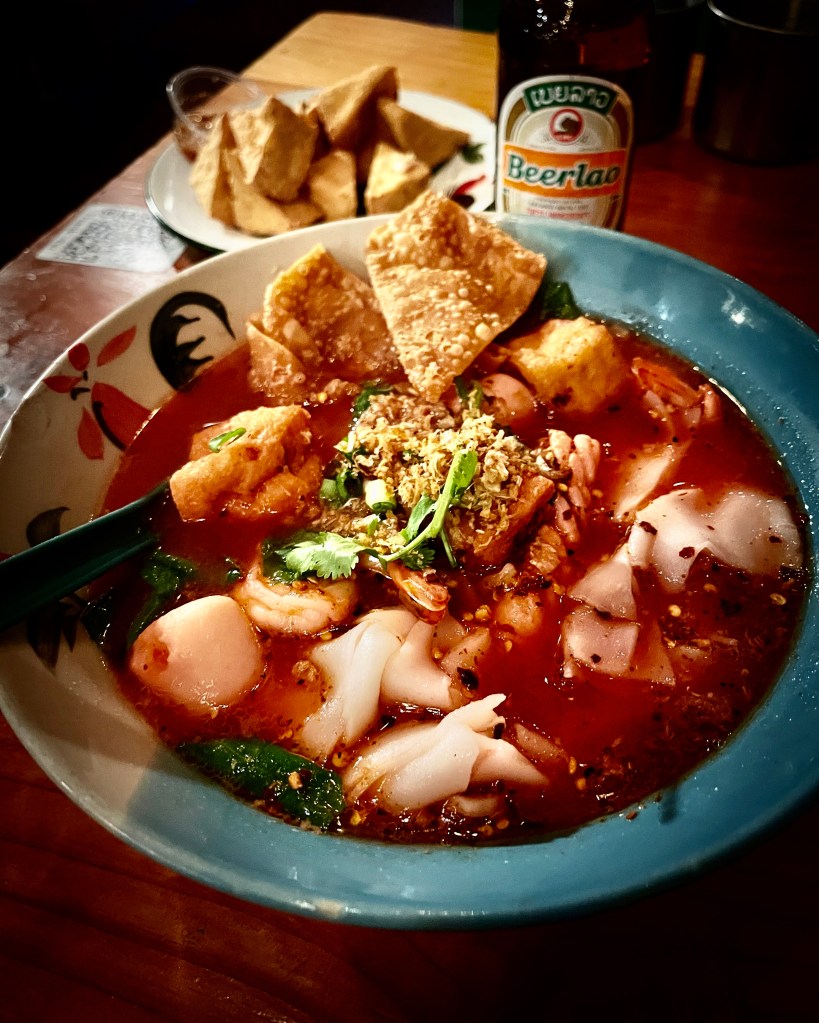
And then came the yen ta fo (written on Bangrak Market’s menu as yen ta four), or pink noodle soup for the way fermented soybean paste turns its noodles the color of a carnation. This would be the last dish of our meal, and the one that has evidently changed my life as an eater. There was me before that bowl of yen ta fo, the old me, the happy-to-lucky eater, blissfully unaware that such earthly delights existed on this celestial plain. Now, there’s the new me, the eater who haunts the food world like a hungry ghost, questing—forever questing—for just one more bowl of the super-duper, flame-thrower stuff. That’s because Bangrak Market’s yen ta fo was, and remains, one of the hottest, spiciest things I have ever put in my mouth. Hotter than melted candle wax. Hotter than the black, Naugahyde seats of a 1966 Dodge A100, left out in the sun, that I once licked on a dare. The moment I slurped a spoonful of that molten-like broth, I started to sweat. Water leaked out of my eyes. It gushed from cervices in my body that had never before produced sweat. It bubbled out of my head. One bite of Bangrak Market’s yen ta fo, and I was a hurt puppy, but one enthralled and enraptured by the intensity of my suffering.
This wound: entirely self-inflicted.
Because, minutes before, upon ordering my yen ta fo, our server had asked how spicey I wanted the dish. The metric I was given: a scale of 1 to 5, with 1 being mildly spicy, and 5 offering spice levels capable of melting the human face.
I chose Level 5, of course, but our server smiled and shook her head.
“I’ll bring you a four,” she said.
Now, after my first bite of the dish, and with my Level 4 yen ta fo still very much in front of me, I reapproached the dish with far more care, knowing that secreted somewhere among its flotilla of prawns, fish balls, and calamari, lurked a large-fanged pit viper of spice, ready to strike. I’d been bitten once, on my first spoonful of broth, and now I was far more trepidatious, fearful of the dish as a culinary agent capable of delivering blows of real pain. Bravely, I soldiered on, moving through my bowl of pink noodles, down, down, down, almost to the bottom of my bowl, while stopping, every few seconds, to wipe my eyes and to blow my nose and cry out in pain.
My wife looked on and eventually decided I’d had enough. I was crying. Snot was pouring down my face. I was making a scene. She reached across the table and gently lifted the spoon from out of my hand. Time to tap out. Time to call it a night. Time to return to our hotel for me to go fetal on our bed, curled up in a ball, readying myself for the scatological reckoning surely to come.
If a meal can be a portal to Nirvana for its eater, then surely my meal at Bangrak Market was just that: a gateway into a world of gustatory transcendence, where every single thing I ate was delicious, and where every texture, every color, every flavor on my spoon made absolute and perfect sense. Nirvana in Seattle, but this time without Kurt Cobain.
Bangrak Market, man. What a magnificent place.
I’ll see you there.
Contact: christopher@proletariateats.com
 Propaganda by Proletariateats
Leave a comment