
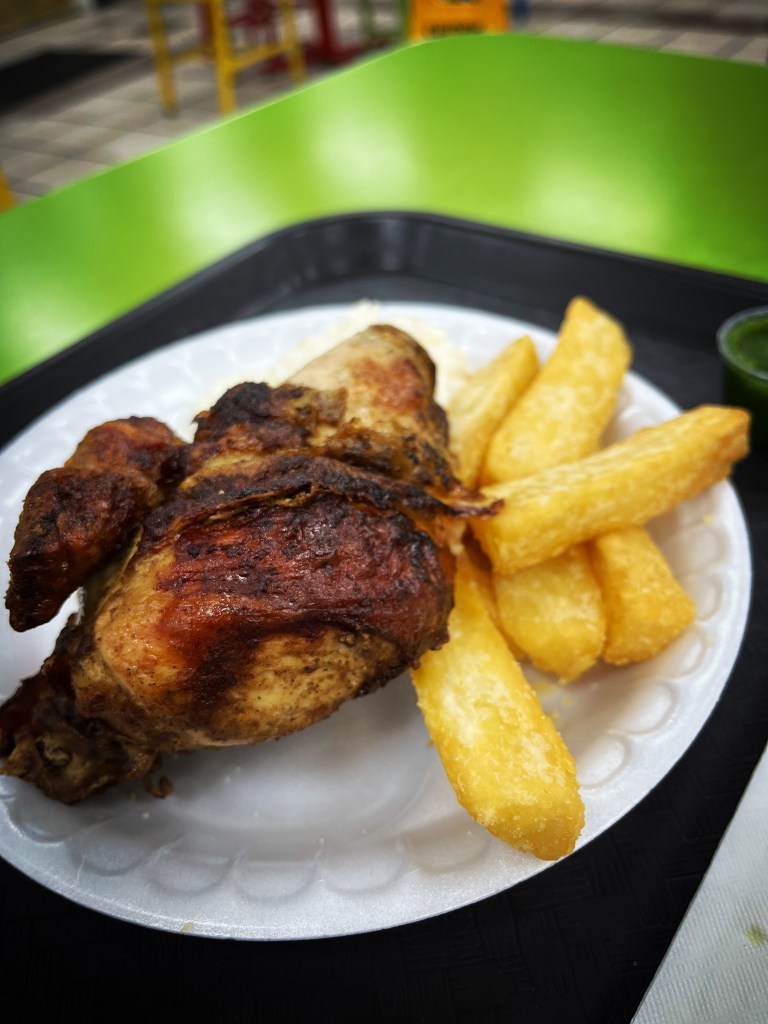
Love at first bite. That’s precisely what occurred at El Pollo Rico on May 24, 2010—a Friday, I recall—sometime around 3 PM, after lunch, when the restaurant was empty and quiet, save the crackle of its charcoal fire, and the Spanish murmuration of its palpably exhausted, post-rush staff. That’s when I first wandered into the little, out-of-the-way Arlington, Virginia, eatery and first encountered some of the most mind-bendingly delicious chicken I had ever tasted.
This was no ordinary yardbird, my friends. This was pollo a la brasa, Peru’s finest culinary export and chicken-cooking technique, whose bone-in perfection I discovered to be simultaneously smokey and herbaceous, with flavors both bright and lively, and altogether unlike any poultry I’d yet eaten. Not fried, of course. Nor broasted. And not quite grilled. Polla a la brasa, this so-called charcoal chicken, was the kind of roasted-on-a-spit bird that had this eater pounding his table with whole-fisted astonishment as he ate, and then a little later in his meal, laughing and giggling and swooning like a schoolboy tickled by the joy of each successive bite. That’s the kind of culinary revelation pollo a la brasa was to me then; such was my cause for elation.
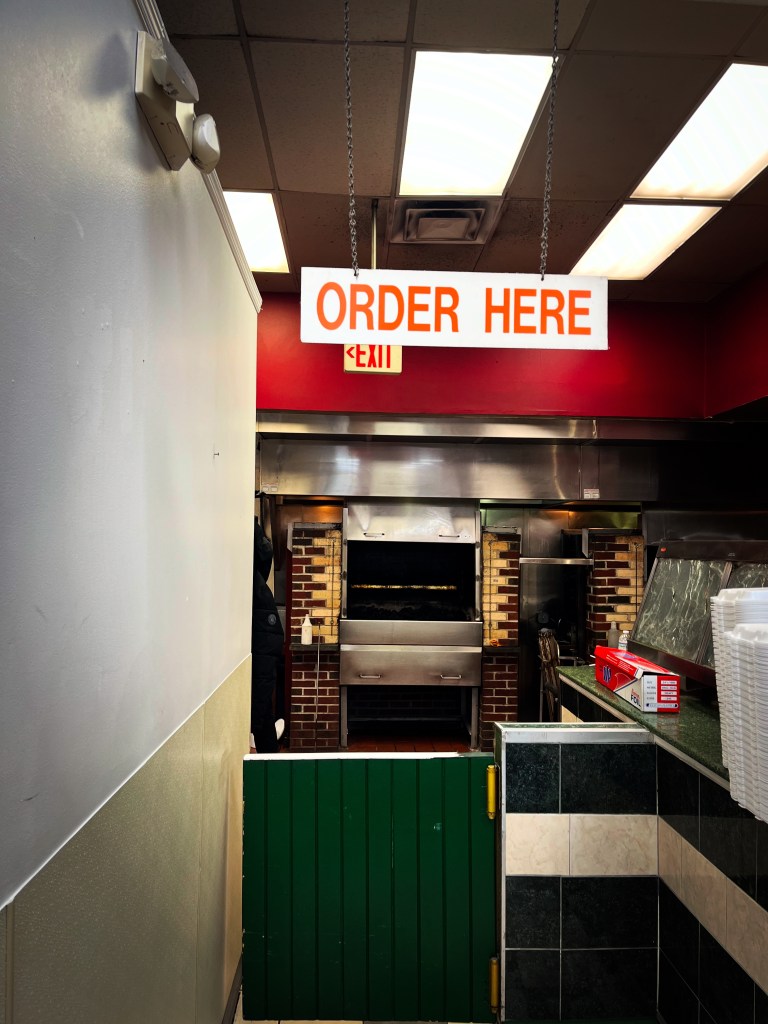
Peruvian chicken is the kind of dish for which eaters of all kinds fall madly in love, a dish those same eaters will then pursue coast to coast, city to city, across their entire lives as gastronomes, and always with low-grade fevers that feel, intermittently, like infection and then infatuation; a food-borne disease for which there is only one cure: a heaping plate of that motherfucking bird.
That’s what happened to me at El Pollo Rico that fateful day in May 2010. In tasting Peruvian chicken for the first time, I stumbled, head-over-heels, into a stupor of gastronomic love that had me declaiming my new-found ardor as a kind of love-sick madness to anyone in the restaurant who might listen. That’s how good it was.
For you peeps out there yet unacquainted with Peruvian chicken, this is how it works: whole chickens are marinated, usually overnight, in a wet mixture of lime juice, olive oil, soy sauce, huacatay, cumin, oregano, and pastes made from aji amarillo (yellow) and aji panca (red) peppers. Those marinated chickens are then cooked on a rotisserie, inside a 450-degree brick oven, over charcoal, over fire and smoke, that blackens the skin and infuses the meat with an unctuousness that will make the eater want to stab herself in the neck with her own fork to better pierce the veil of what must surely feel like hallucination, so great is her amazement at what she’s tasting.
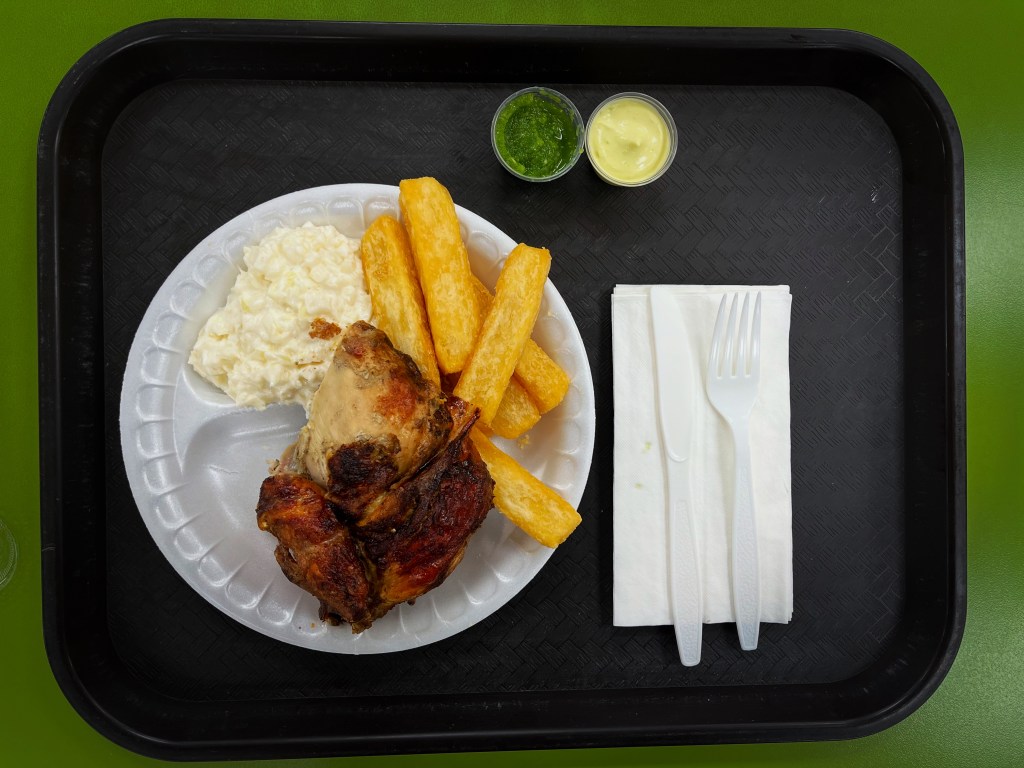
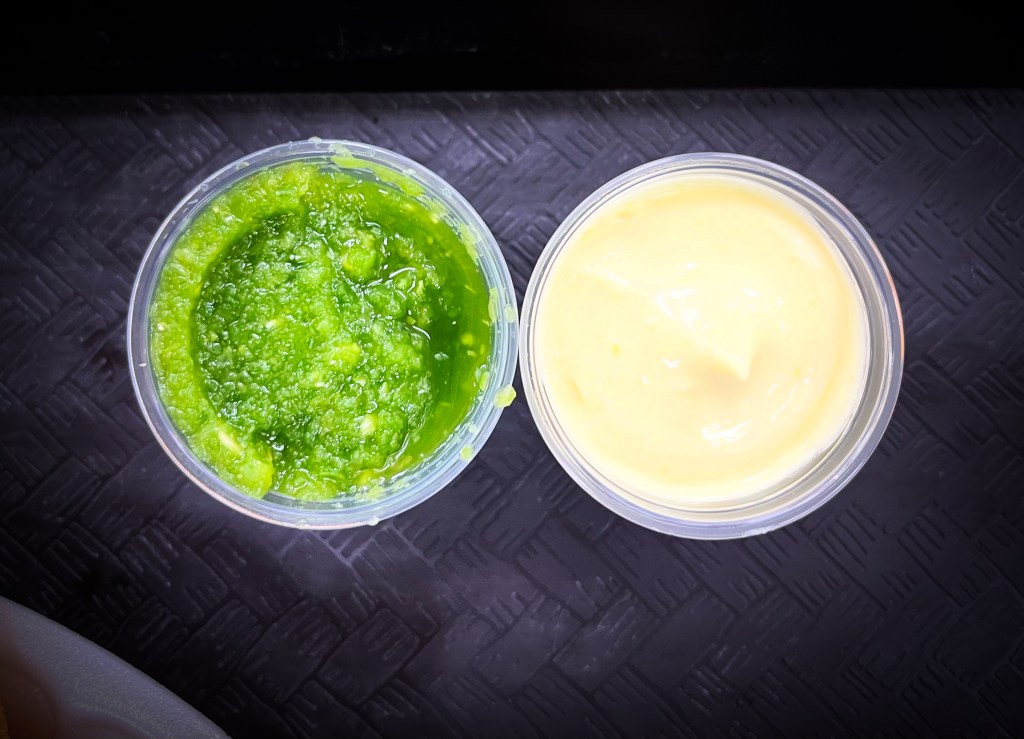
With the chicken comes a traditional pairing of yuca frita (fried yuca) and two kinds of sauces, el aji pollero (think sweetish, yellow-pepper aoli), and a feisty puree of pure, green jalapeno for added zing. You eat this, this chicken, the yucca, the dipping sauces, with your bare hands and bared teeth, gnashing at chicken flesh and bone, until your mouth is suitably slathered with smoke-black herbs, and your fingers are positively dripping with rendered poultry fat. Feel no shame in this, friends. Instead, revel in the primal pleasures of it all. Because at El Pollo Rico, this is how it’s done, sans hesitation or compunction, just like they do in Peru.
Which is ironic. Because Peruvian chicken is not entirely Peruvian. Not exactly. Peruvian chicken is Swiss, in a way. Invented in 1950 by Lima-based Swiss national, Roger Schuler, for consumption in high-end restaurants, and aided, later, in the chicken’s mass production by fellow countryman-in-exile, Franz Ulrich, pollo a la brasa was soon adopted by Peruvians as Peru’s national dish. Not as haute cuisine, as originally intended, but as food for the masses, food to be proudly eaten with one’s own toil-covered hands. And just how popular did pollo a la brasa eventually become in Peru? Popular enough to have poultry-addled Peruvians consuming the dish three times a month, on average. Today, a whopping forty-percent of Peru’s fast-food restaurants serve this style of charcoal/rotisserie chicken. That’s how bonkers Peru is for the stuff. That, too, is how Peruvians have come to crack the code on poultry’s perfection: because practice makes perfect, and culinary perfection is most certainly what pollo a la brasa embodies.
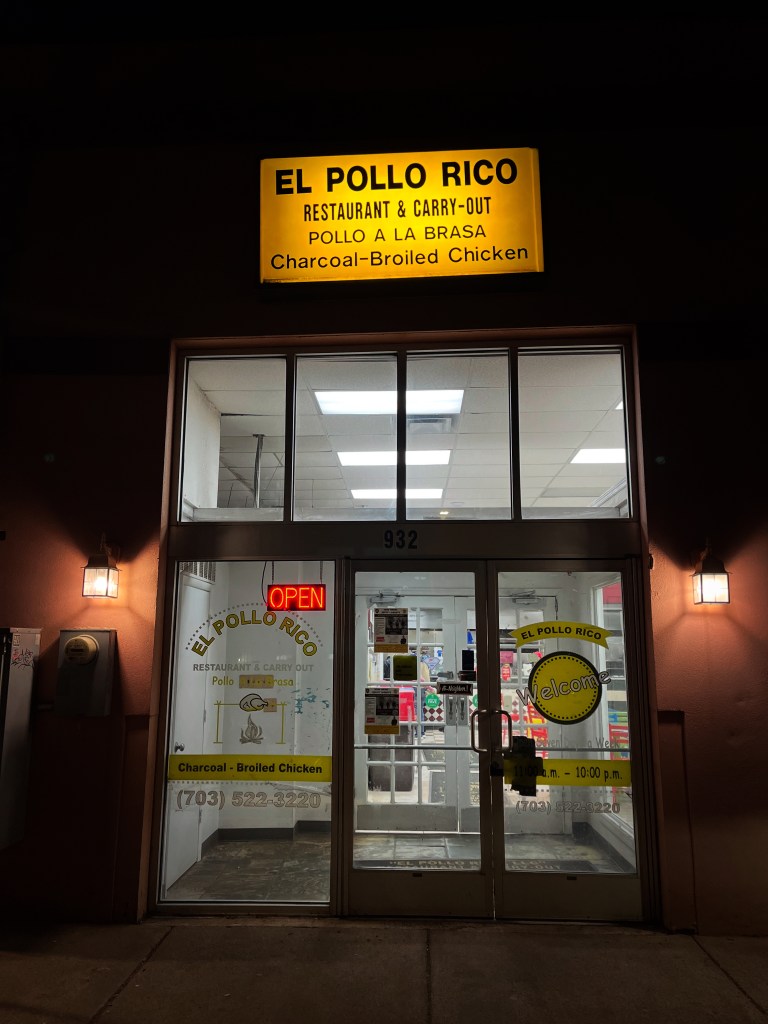
Enter, then, El Pollo Rico, Washington, D.C.’s answer to the Peruvian chicken craze. Founded in 1988 by Peru native, Victor Solano, word around D.C. of the Arlington chicken joint’s greatness quickly spread, and soon El Pollo Rico found itself catering to a cult of crazed devotees, whose ravings, on-line, about the restaurant’s supremacy would eventually attract luminaries to the restaurant like Serena Williams and Anthony Bourdain.
And me.
In May 2010, hardly famous, I came to El Pollo Rico party as a mostly-anonymous, late-arriving guest. Not only did I come late, I came as that guy, that loud-mouthed lout, who sits in corner, pounding the table with his fists, hoping his cacophony of blunt-force noise would sufficiently articulate the scope of his gustatory bliss.
But that first experience with El Pollo Rico—transformative as it was—is, today, fifteen years in the past. That’s a culinary lifetime ago. What’s the restaurant like now, in 2025, I wondered? Did it still resemble the El Pollo Rico yore, that one, culinary powerhouse in near-suburban Washington invariably capable of producing the area’s very best bird? Or had the shine worn off by 2025? Had El Pollo Rico succumbed to the spiritual malaise now endemic within the food industry in this post-pandemic era of poor service and indifference to innovation? Did El Pollo Rico find itself, now, diminished? Was it, at present, a paler, lesser version of its once-mighty self?
Only a journey to El Pollo Rico would reveal what I needed to know.
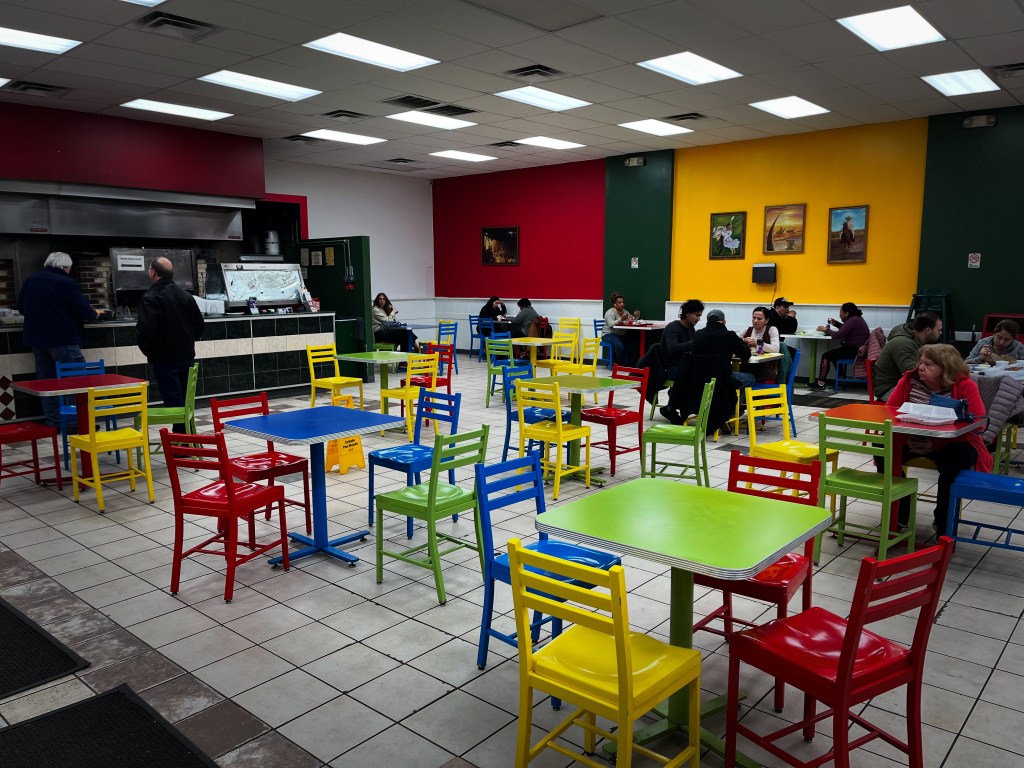
So on a recent work trip to Washington, my old home town, I decided to pay El Pollo Rico a visit. I took Metro to Clarendon, and then walked a half-mile through the always-pleasant Virginia Square neighborhood, only to find the El Pollo Rico I once knew absolutely unchanged, as if preserved in culinary amber, and still haloed in gustatory glory. It remained as it once stood: every bit the bastion of culinary excellence I believed it to be.
That’s because the restaurant, and everything that once made it so excellent, was perfectly intact. Approaching the restaurant, I enhaled the same chicken-scented wood smoke forever billowing across its always-crowded parking lot. Inside El Pollo Rico itself, I found the same dining room I once knew, with its Romper Room color scheme, across whose breadth ran its venerable service counter. And there, at that selfsame counter I’d leaned against so many times in years past, I ordered the very thing I’d ordered in 2010, and again on nearly every visit to El Pollo Rico since: a half chicken with fried yucca and two sauces, yellow and green.
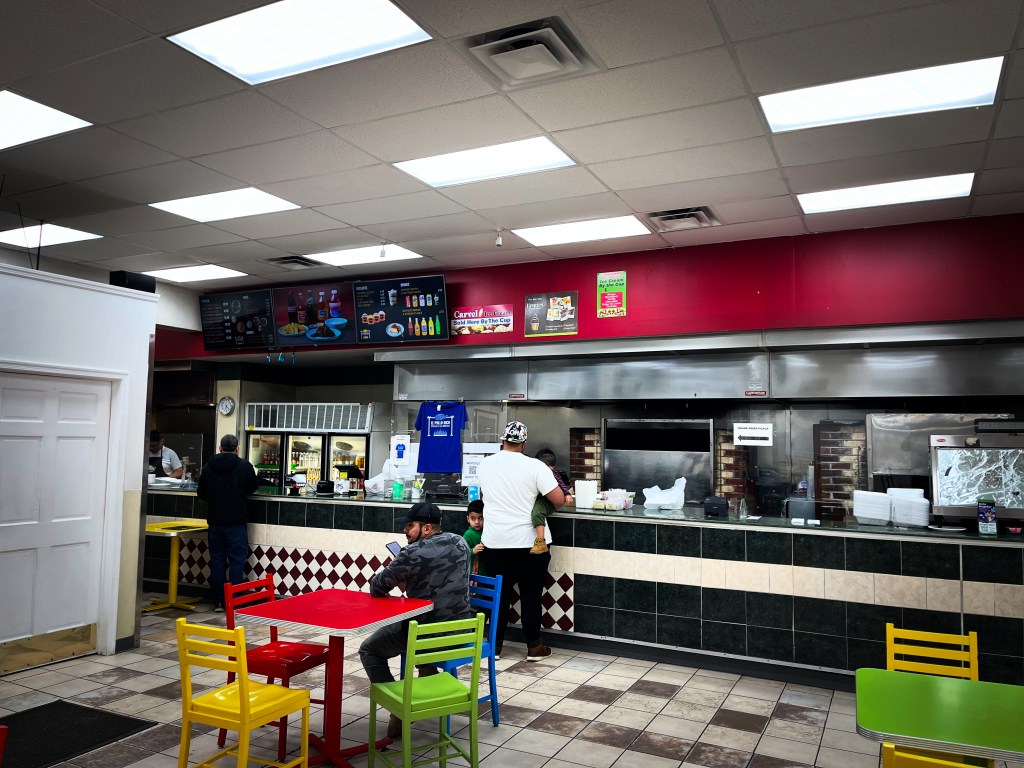
My pollero behind the counter nodded at my order. Out came his cleaver, and suddenly, the chicken on his cutting board was split in half. Onto a Styrofoam plate went my half chicken, along with an order of yucca frita, and a dollop of super-creamy coleslaw. Onto that same plate were added tiny cups of sauce. I paid at the register, and then off to the races I went, sitting alone at my favorite corner table, napkin tucked under my chin, eating like a man who’s not seen food in days. I fell onto my chicken with a ferocity that had fellow eaters at nearby tables side-eyeing me with equal parts befuddlement and admiration as I involuntarily grunted and groaned and made sex-noises at the food I ate. Animal noises. Noises guttural in pitch. Noises that would make any casual observer blush.

Before I’d finished that first piece of El Pollo Rico dark meat, I knew the restaurant’s chicken was every bit as delicious—smokey, juicy, and herbaceous—as I remembered. And yes, the yucca—perfectly fried and salty—still punched harder than white-potato fries might, and far, far above its own weight. Even the yellow sauce, that magnificent el aji pollero, remained good enough to make me want to run my tongue around the rim of its empty little cup. My meal at El Pollo Rico was an absolute triumph, and I knew with absolute certainty that this restaurant in 2025 is every bit as good—if not better—than it had once been, way back in the good-old-days of 2010.
And so there I sat, elbows on the table, hunched over my plate of denuded chicken bones, my mouth smeared with smoke-blackened herbs, my fingers slathered in fat. More than well-fed and happy, I felt a sense of relief. Because after so many post-Covid years of speculation and wonder, I knew El Pollo Rico still reigns supreme. Soon, my relief turned into something akin to ebullience, rising up, through my chest, on the now-certain knowledge that El Pollo Rico’s spell over me remains unbroken, that the fever of my infatuation with the place endures, and my love for its incredibly delicious pollo a la brasa very much abides.
 Propaganda by Proletariateats
Leave a comment