
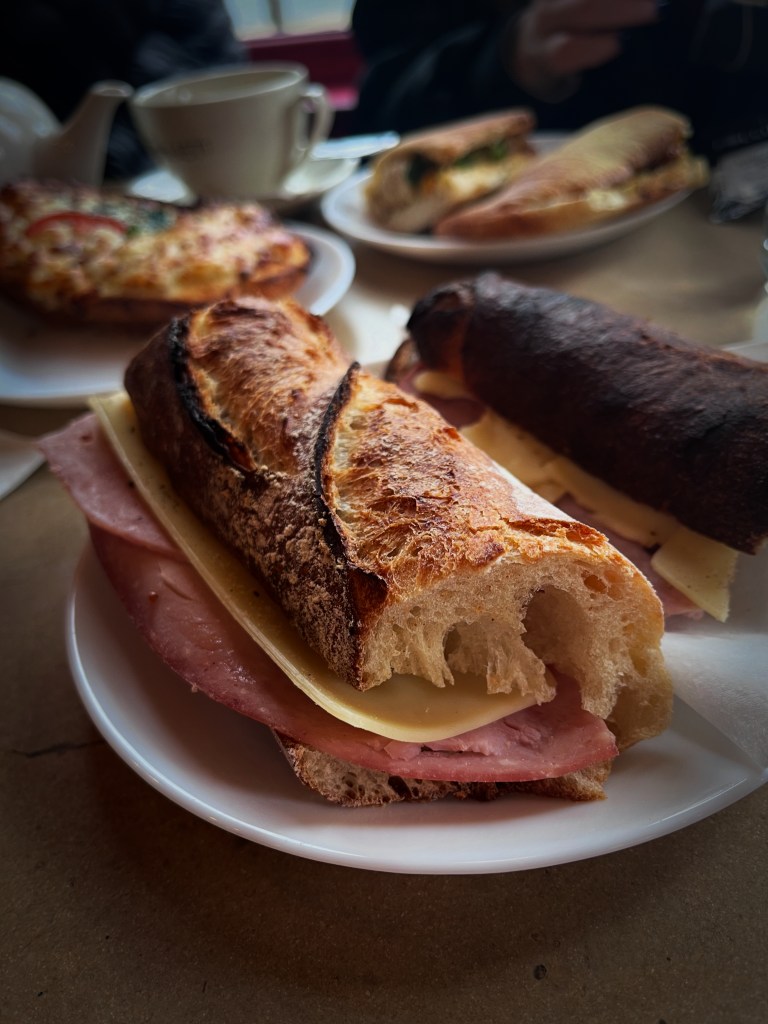
Oh, Paris. What to say of thee, my love, that hasn’t been said before? That you are the fairest flower of the culinary world? That the redolence from your boulangerie surpasses in olfactory bliss the bloom that any magnolia or rose might otherwise proffer? Or that your fine-dining restaurants routinely defy culinary gravity and bend gastronomic light?
Paris, you are a culinary wonderland, the apotheosis of all that is good in modern gastronomy. The very quintessence of culinary nirvana, you with your vast legion of restaurants and seemingly endless bounty of good things to eat.
And therein lies the rub, does it not, dear city? This paradox of plenty that this loving of you so neatly conceives? Could it be that your gastronomic allure shines too brightly, and that to behold your beauty is like staring into the sun? Could it be your benefactions are so plentiful as to dizzy me from the vexation of almost infinite culinary choice?
This has been playing in my head since landing at Paris’s Charles de Gaulle International two hours ago. The words above. This soliloquy of veneration for culinary Paris as I now walk its streets, suddenly doubting my own ability to find a truly great culinary experience from the thousands of fine-dining possibilities at my feet. Three days in Paris; three chances to find the perfect meal, and me, afoot in the City of Lights, choking under the enormity of all this pressure to perform as an eater par excellence.
Water, water everywhere, and not a drop to drink.
What a strange dilemma in which to find myself.
What to do?
Should I follow the stars, as they say, and eat at Plenitude, the restaurant helmed by Arnaud Donckele, he of three Michelin stars, I wonder. Or should I dine at Chef Yannik Alleno’s storied namesake, Alleno Paris au Pavillon? Maybe I should grab a bite at the famously delicious Laperouse, I think. Or perhaps securing a table at the venerated La Belle Epoque is in order.
The paradox of plenty, indeed.
An hour after landing in Paris and wandering its streets, pressing my nose against bistro windows, and poking my head through brasserie doors, I finally land on an idea: fuck it. Fuck the Michelin-starred places and fuck having any semblance of knowing where I’m going to eat.
My plan to eating in Paris: no plan at all. And no stars. I’ll simply meander its streets like some culinary flaneur, arrondissement to arrondissement, from the 17th to the 1st to the 5th, the way a scrap of errant excelsior might find itself blown by a capricious wind, until the siren’s call of some random restaurant brings me inside, and then tableside, to sit before an equally random plate of food.
A roll of the culinary dice.
The geometry of gastronomic chance.
Chaos will rule the day in Paris.
Meal One – Tonton des Dames – 17th Arrondissement
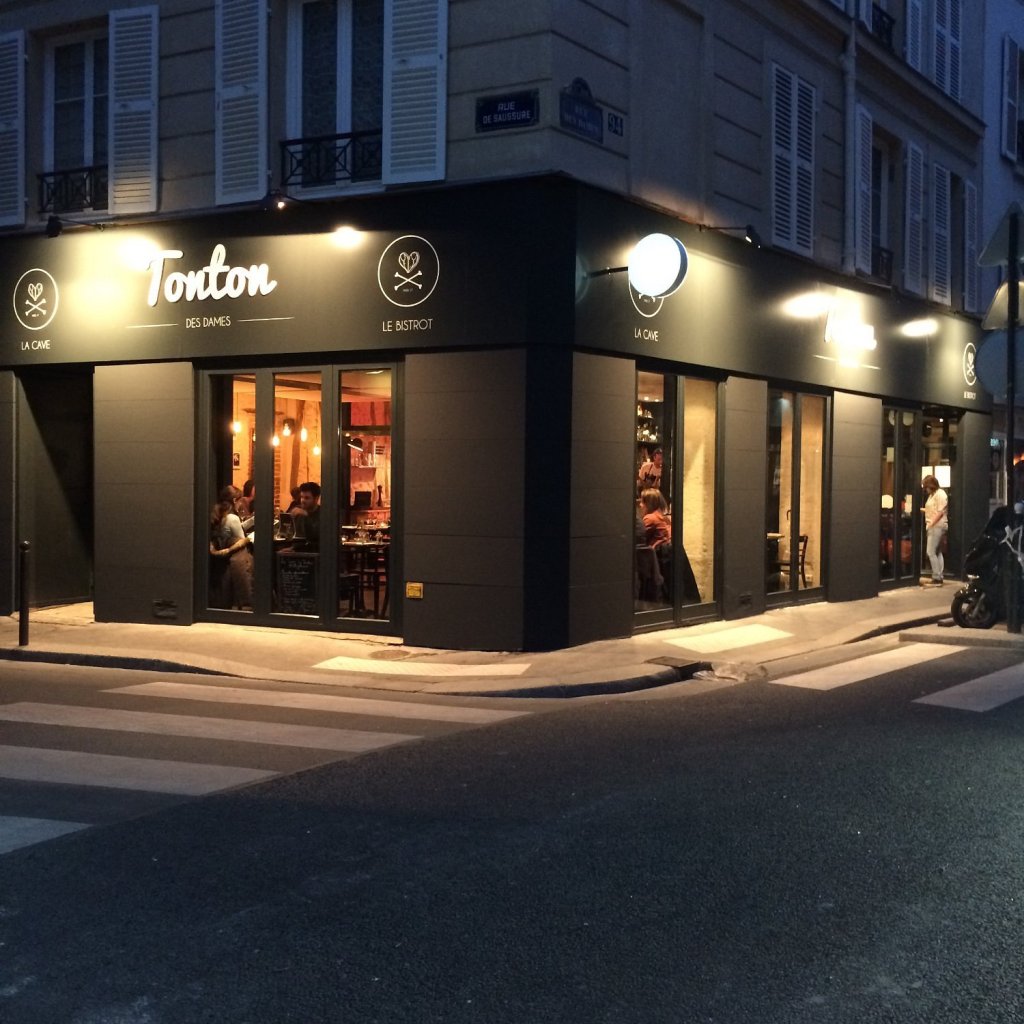
They say you find true love the moment you stop seeking it. How neatly this adage explains my relationship with Tonton des Dames. The minute I surrender any notion of finding the perfect Parisian restaurant, here it is: love at first sight.
Tonton des Dames is the Platonic idea of a Parisian restaurant: a neighborhood joint that feels like a warm hug; an eatery brimming with laughter and conviviality, all the while serving the finest, meat-centric fare that feels further elevated by a demonstrable mastery of technique. Simple dishes made exquisitely delicious through expert sourcing and a culinary know-how evident in every bite. That’s Tonton des Dames. And that’s why I adore this restaurant with the white-hot passion of a thousand suns.
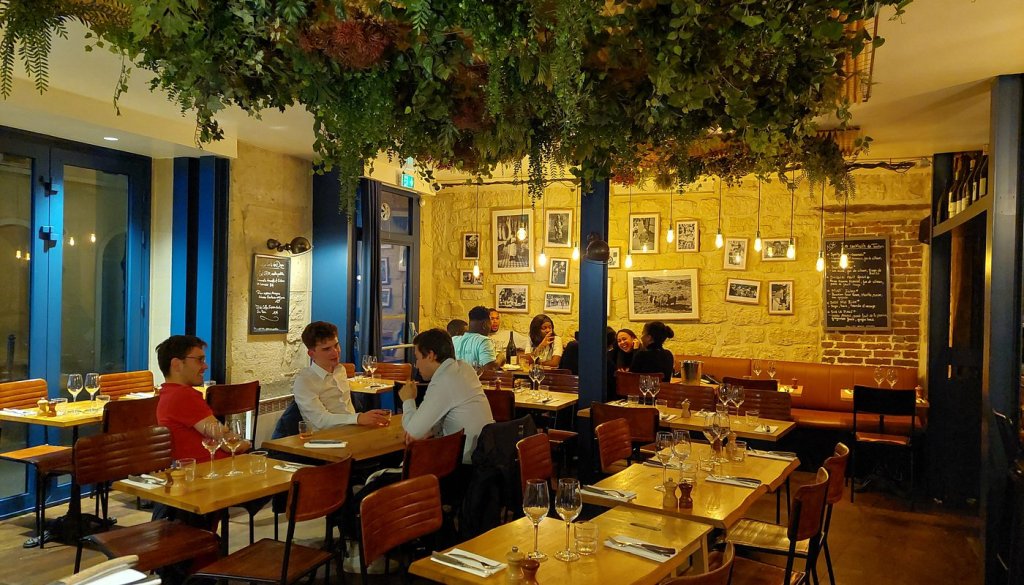
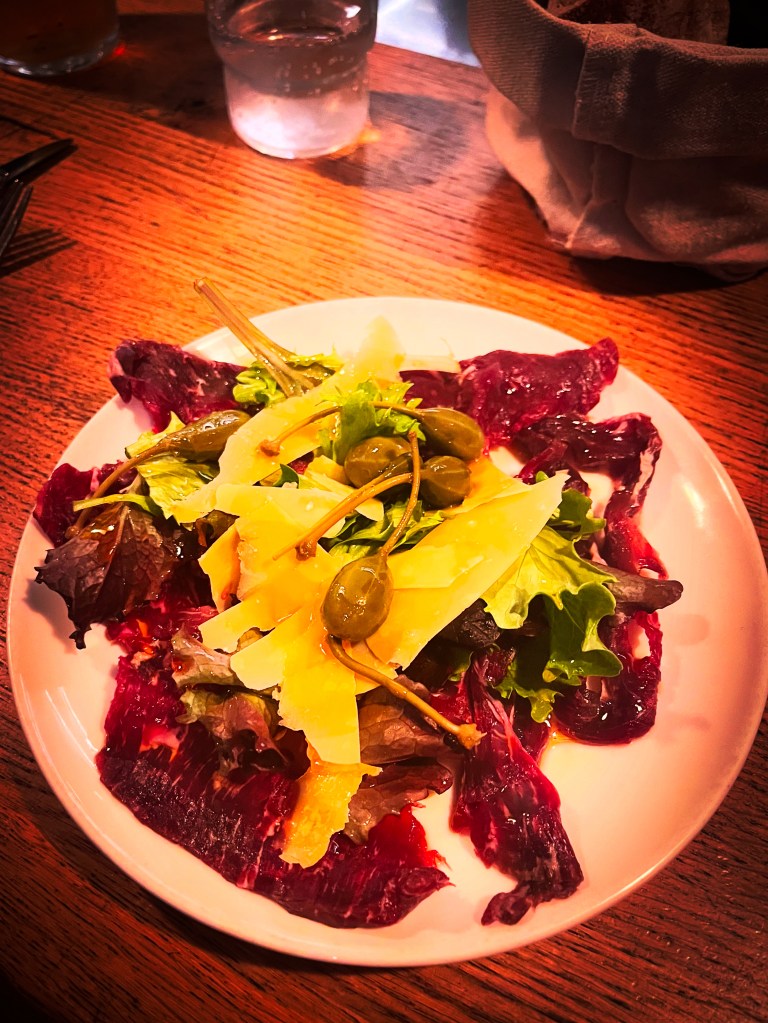
I sit at the bar and order beer in terrible French. My server smiles indulgently, the way adults will quietly suffer the conduct of dimwitted children, and gently moves the conversation to English, suggesting I start my meal with a couple of Tonton’s most beloved stalwarts—carpaccio de boeuf de salers fume and the pate croute volaille et fois-gras—before proceeding to a main course of ½ coquelet, accompanied by an order of aligot, and a side of champignons en persillade.
Absolument.
Simple is hard. Especially in gastronomy. Because teasing culinary greatness from the most quotidian of ingredients—an ordinary rooster, workaday mushrooms, average potatoes—requires more than just a mastery of technique. It requires the courage of an assassin, and the kind of daring that lives inside every alchemist’s heart. To cook simply, as they do at Tonton des Dames, is to stand before a tribunal of culinary adjudication; it’s to stand naked before the truth.
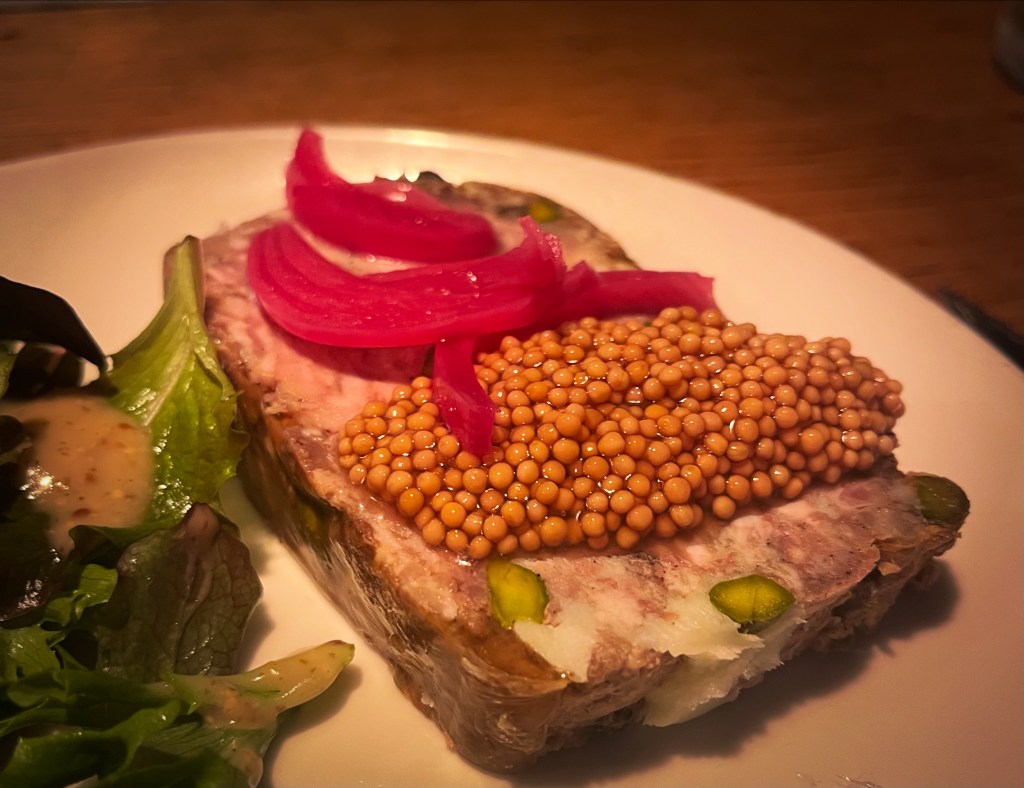
To describe my meal at Tonton as merely delicious would be an affront to the hermeneutics of food writing. Delicious, as a descriptor, would be an act of linguistic violence to the langue and parole of my intended meaning. Because delicious doesn’t describe the half of it, folks. Mind-bending is better. Transcendental comes closer still.
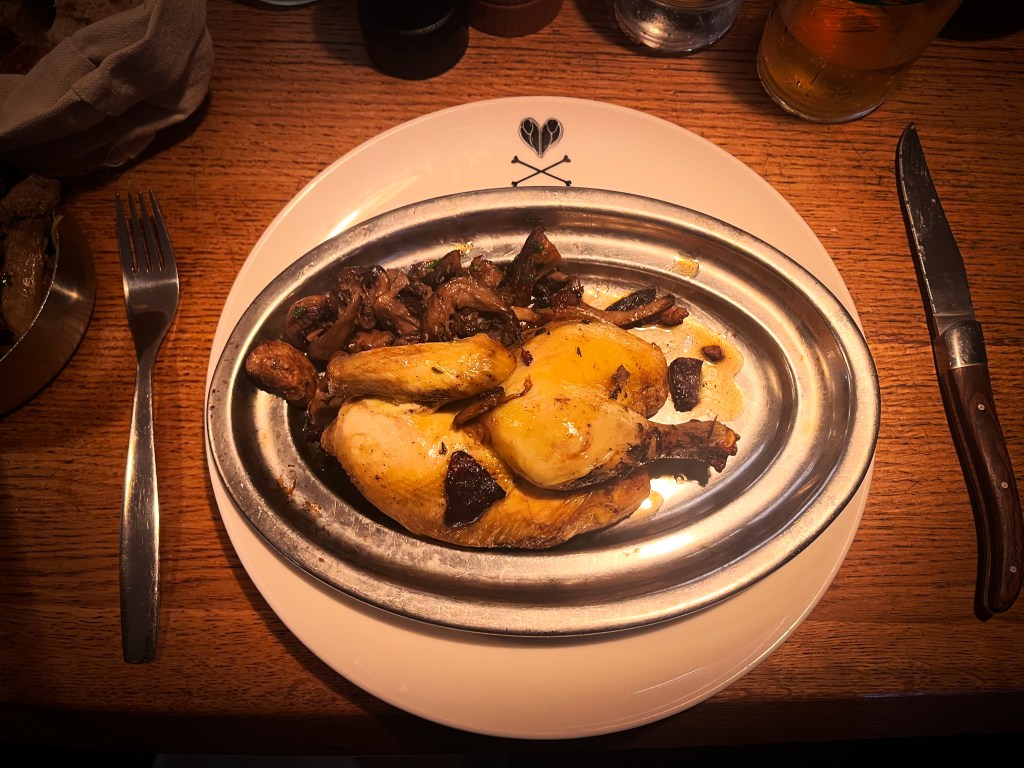
Because simplicity is the one, unifying, and entirely magical ingredient on Tonton’s menu. Simplicity is the palpable in every dish I taste. It’s the deliverance of the dish’s very essence in its purest form, and this kind of culinary conveyance is the very best flavor I know. Simplicity is what I taste in my chicken. Under the smoke, it’s what I taste in my beef carpaccio. It’s what I taste just beneath the minerally zing of my pate. Simplicity, as a flavor, is the culinary consequence from which the mastery of technique arrives. Simplicity is elemental, and it’s in every dish Tonton lovingly serves.
Transcendental, indeed.
Meal Two – Au Rendez-Vous Des Artistes – 9th Arrondissement
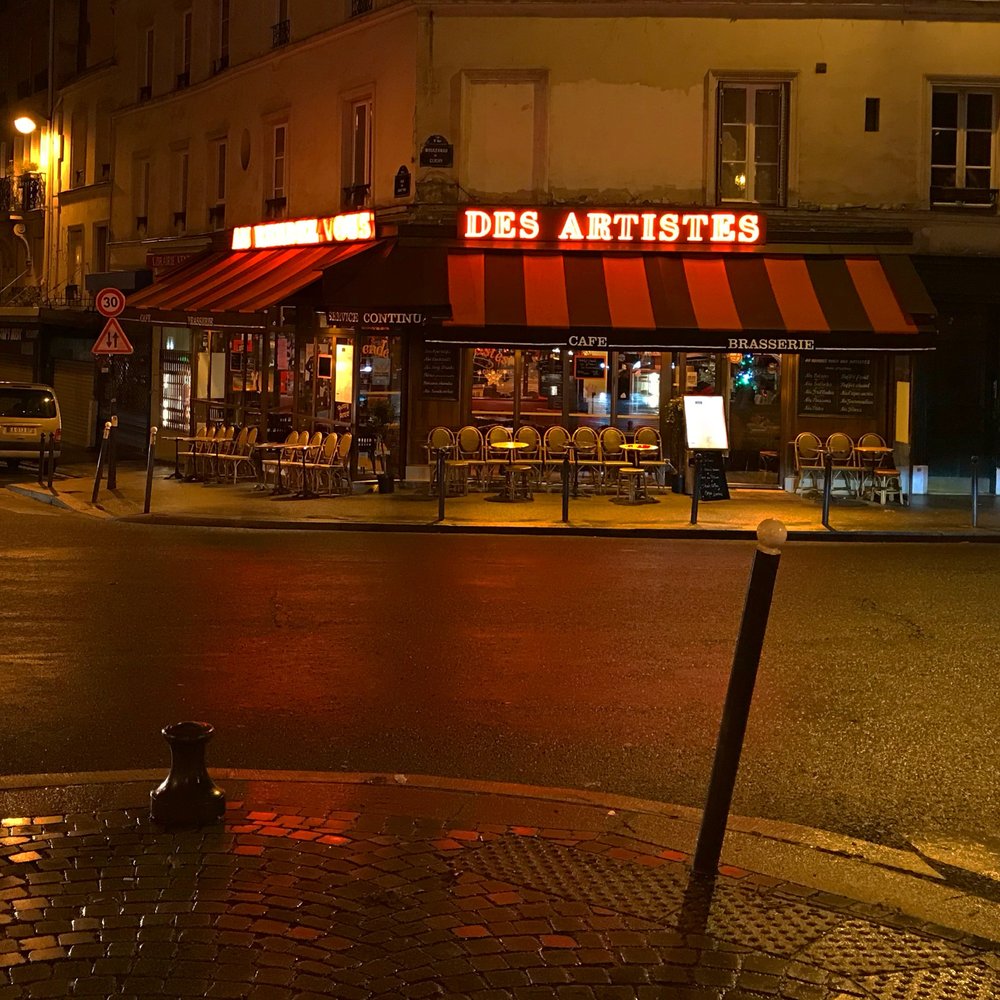
Americans are right to consider the Parisian café kindred to the American diner. The Parisian café, like the diner, is deliberately unfussy in its culinary aesthetic, and intensely proletarian in its gastronomic pride. They’re similarly unfettered by tyranny of the mealtime clock, these cafes, offering Parisians omelets at midnight, and steak frites at 6 A.M. The kind of place into which a weary traveler like me might stumble, rain-soaked to his skivvies from his trapse around Montmartre, and in desperate need of warmth and nourishment. A place precisely like Au Rendez-Vous Des Artistes.
It’s a loving embrace, this café, and almost cinematic in its décor with its red walls, bent-wood chairs, and black-and-white tile floors of your Parisian dreams. As a restaurant, Au Rendez-Vous is pleasantly funky and worn-at-the-edges cool. It’s a proverbial warm bath; a broken-in bedroom slipper. The kind of place where old men stand around the bar, pounding glasses of Kronenberg, debating the virtues of socialism, and petting, as they do, the little Shih Tzu who lives in a dog bed atop the counter.
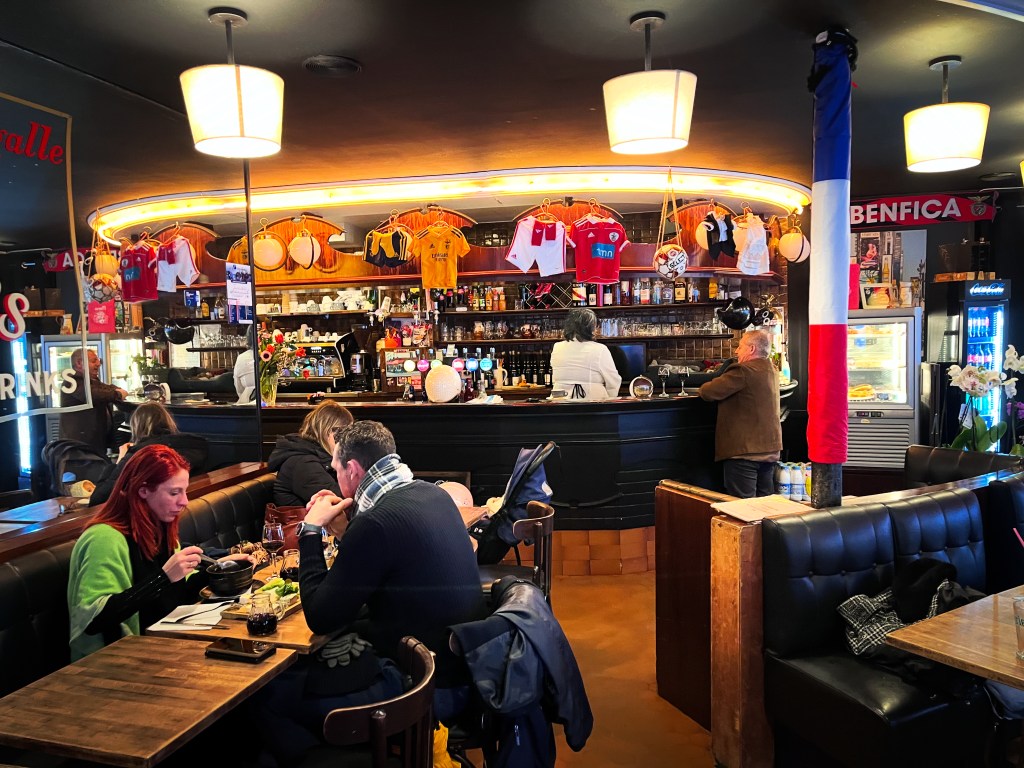
My server at Au Rendez-Vous is a woman, heavily tattooed and middle-aged like me, with thick arms and an ebullient smile. She sits me at a tiny, marble table before wiping rainwater from my face with her apron. Then she presents the day’s specials, written in chalk across an enormous board, which she stands in a chair, and to which she excitedly points. The options are many. But so enchanted am I by last night’s roast chicken from Tonton that I order it again, here, today, at Au Rendez-Vous, but with an additional side of oeuf mayonnaise and French onion soup, only because I’m astonished that real-life Parisians actually eat French onion soup.
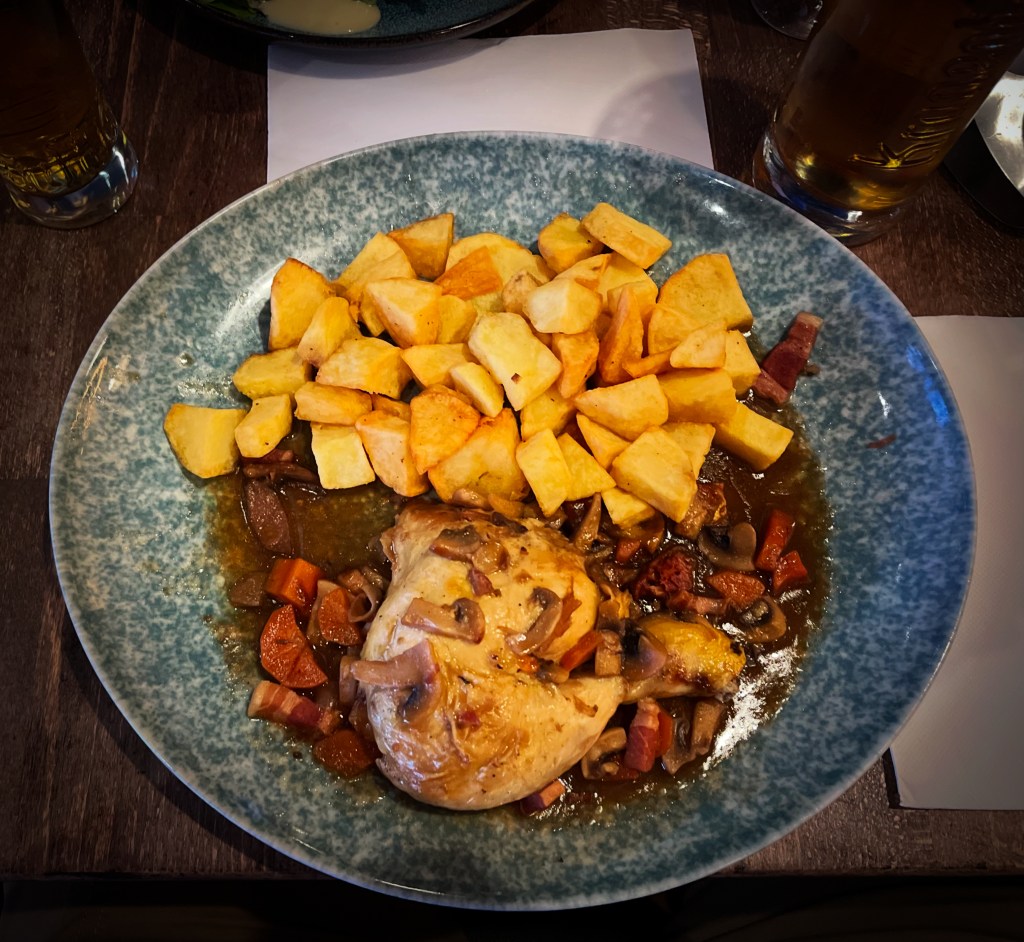
The food I’m soon given is decidedly workmanlike in technique—I’m expecting this—but it’s also soul-affirming in its deliciousness, and for the way it so perfectly replicates the love and care of a home-cooked meal. It’s as if someone’s grand-mere has just prepared my food. My chicken is perfectly roasted and umami-rich with its mushrooms, lardon of bacon, and jus that punches well above its weight. The French onion soup is homey and rich. But it’s the oeuf mayonnaise, people, that’s the star of this show, and for reasons that defy all explanation.
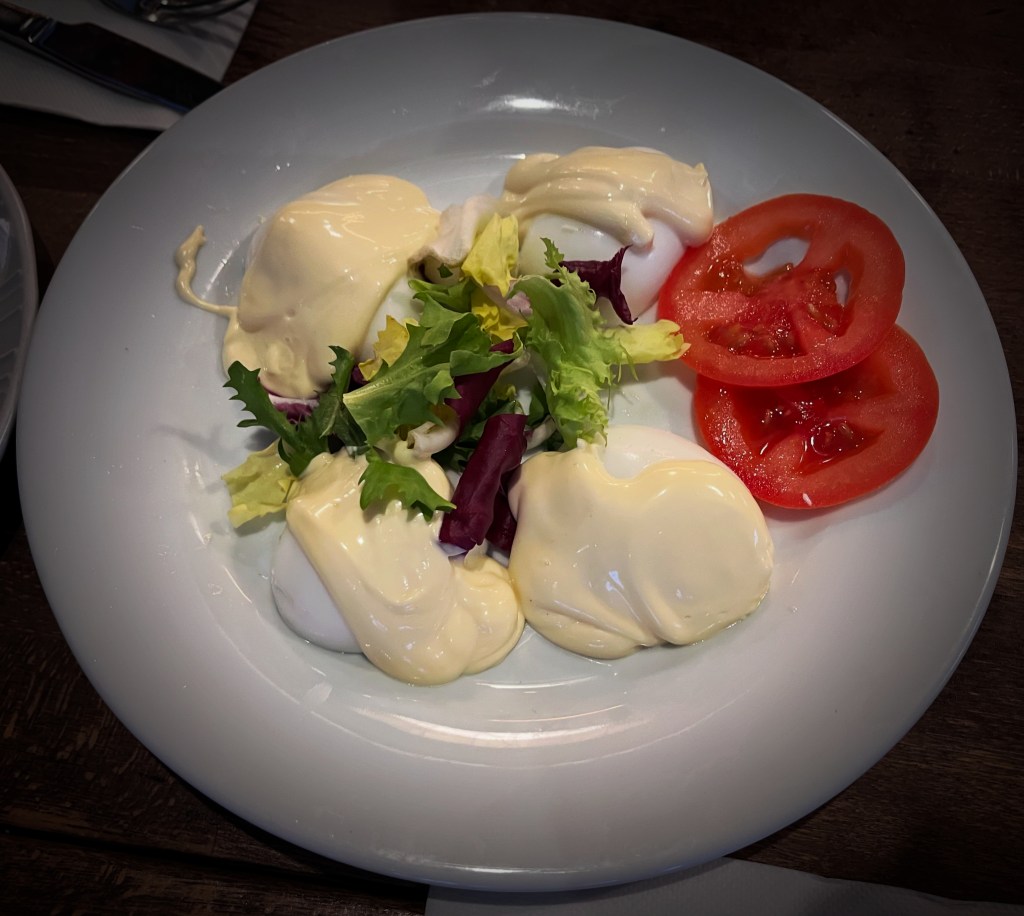
That’s because the eggs are overcooked—two minutes too long in too-hot water, I’m guessing—with chalky yolks green at the edges with ferrous sulfide. They’ve unceremoniously been placed face-down on the plate, like murder victims whacked by the mob, and they’re drenched in a mayonnaise thinned with Djon mustard and lemon juice. The garnish of undressed greens and unripe, unsalted, out-of-season tomato comes as an afterthought, of course. No part of this dish is working, right? Nothing in this effort is a success, yes? But holy mother of God are these eggs are good. They are a masterwork of bistro cooking, and likely—spoiler alert—the very best bite of food I will encounter this entire trip. They’re fucking magical, these eggs, the culinary wizardry of some aged and all-knowing grand-mere hidden away in the Au Rendez-Vous kitchen like a gastronomic gnome, ashing her Gitanes into the soup, bewitching eaters with her cooking.
I love you, Au Rendez-Vous Des Artistes, je vous aime.
Meal Three – Le Petit Poucet – 17th Arrondissement
With all this talk of simplicity and home cooking, it’s easy to forget that French culinarians are absolute masters of precision. Exactitude in preparation and plating is the hallmark of French technique, and the cuisine produced by this technique is often godlike, I think, in its ability to transport the eater to culinary Canaan. Battle-tested samurai are what French cooks are, with hearts forged in fire, and each sworn to exemplify codes of culinary conduct, wholly military in aspect, that would make many American cooks wet their beds and cry out for their mommies. Serious culinarians doing serious fucking work, all the time, no exceptions. That’s the French way.
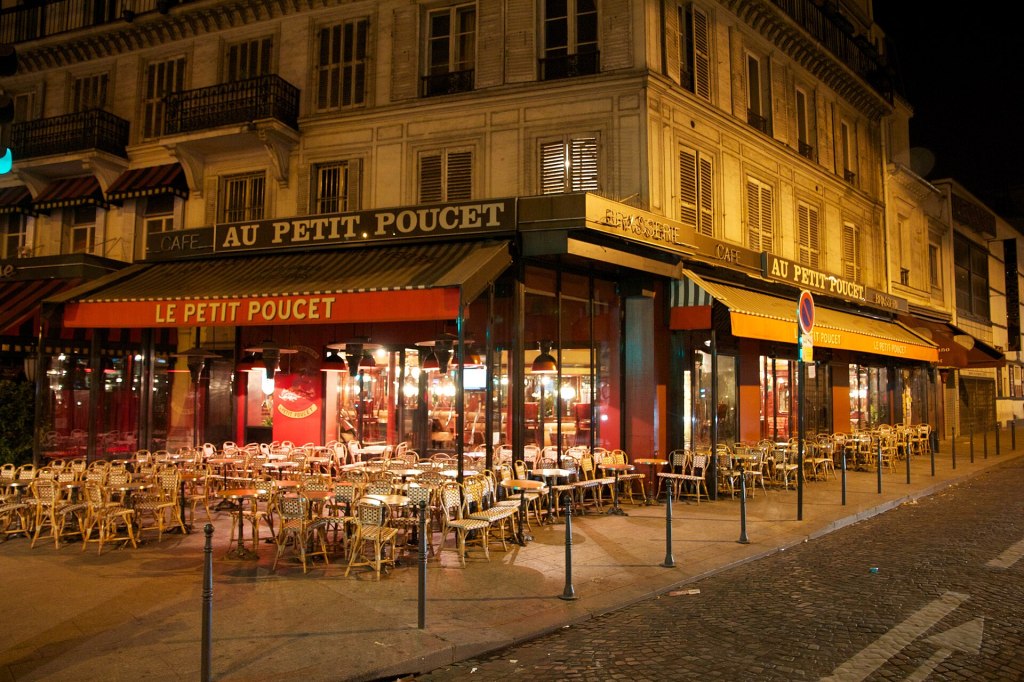
And that’s how it’s done here at Le Petit Poucet, a brasserie in the bustling Place de Clichy, in Paris’s 17th. Don’t let this notion of the brasserie fool you. This is not some neighborhood slop house serving up watery omelets and vichyindifference. Not here, boy-o, not at Le Petit Poucet. Oh, sure, the vibes might seem chill—patrons lounging at tables, thumbing the day’s Le Monde—but the culinary mission here is clearly life-and-death for these practitioners of French gastronomy.
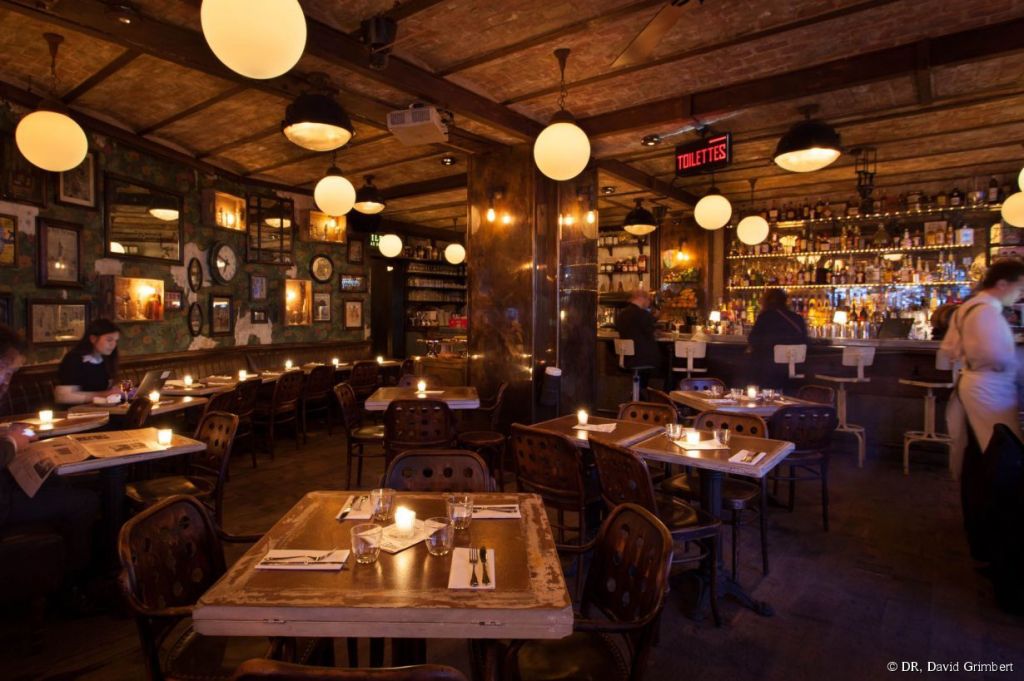
Even the mood front-of-house seems austere. The maître d’ seats me the way an usher would seat a funeral guest, and with glass-chewing solemnity. My server is equally grave. She’s in her middle twenties, I’d guess, in a black apron, with red lips, and hair tied back in such a way as if to lift her eyebrows in a perpetual look of surprise. Her manner is formal and perfunctorily polite, like that a house cat willing to be admired, but never petted. On this server, I catch a whiff of that famous Parisian hauteur, a smell which American olfactories often misread as rudeness, but which, in reality, is only the reek of abyssal self-possession. A quality I admire deeply, by the way.
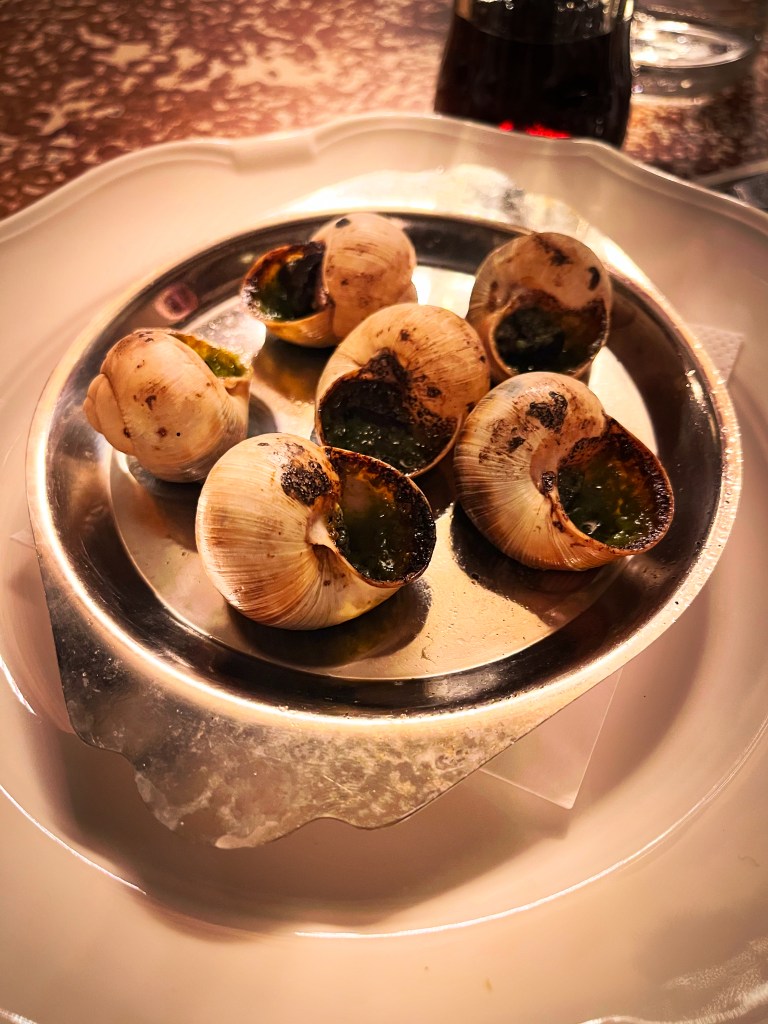
I order escargot because I’m in Paris, after all, and why the fuck not? I also order the filet de daurade et beurre blanc, or sea bream in butter sauce. My snails arrive first, and they are magnificent. Because underneath all that garlic and parsley, I find the cleanest tasting half-dozen gastropods I’ve ever had. They’re the kind of snails one finds only in France: lovingly hand-fed for two weeks on Belgium endive before they’re shuffled off to buttery graves.
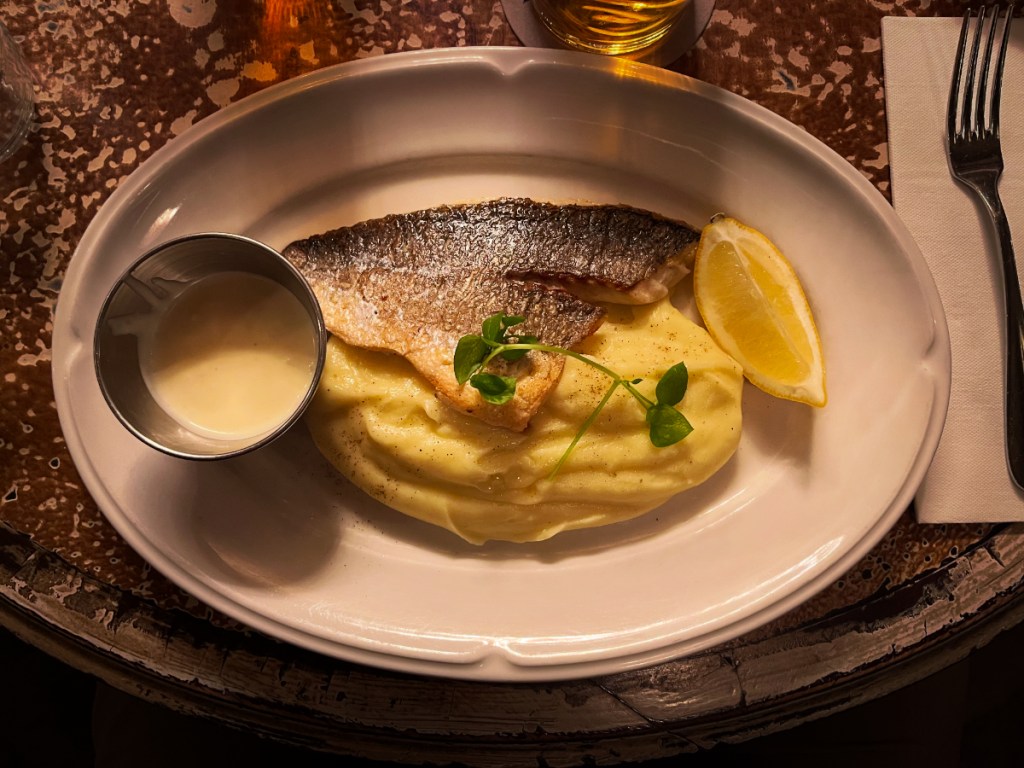
Good as these snails are, it’s the bream that steals the show: a dazzling, four-once filet of fish, pan-seared in such a way as to make the skin almost chicharron-like in its crackly crispiness, while leaving the uber-delicate flesh, underneath, as pillowy and pliant as the dreams of a newborn child. My filet de daurade is a master class of fish cookery. It’s the embodiment of culinary exactitude, the epitome of French technique perfected. It’s Hugo’s Hunchback of Notre-Dame. It’s Debussy’s Clair de lune. It’s Duchamp’s Nude Descending a Staircase. This fish is a French national treasure. It’s everything I ever want from a plate of food. And it’s a motherfucking triumph. Bravo, Le Petit Poucet, bravo.
La Conclusion
Of course it’s possible to have a bad meal in Paris. Visit any of the ex-pat joints near the Eiffel Tower, or by Notre-Dame, the ones posting menus in English and peddling hamburgers to slack-jawed tourists from Oklahoma, and you’ll have landed in a world of culinary mediocrity, one populated by unscrupulous rubes peddling absolute shit to eaters too incurious to surmount their fears of the culinary unknown by never daring to light out for the territories.
But just at the edges, inside the dark, hidden corners, is where the good stuff lies.
This we know. Yes. But in Paris, it’s gospel.
Venture to any of Paris’s outlining arrondissement—the 17th and 18th, the 9th and 10th—and you’ll discover that culinary greatness abounds on every street, and in every brasserie and bistro. Gastronomy is the thing that flutters the ventricles and valves of this great city’s heart, this greatest of food cities. It’s also the thing that makes eaters, like me, fall helplessly in love with Paris, a love requited by some of the greatest meals of my life.
Here are just three. Three days. Three meals. A lifetime of epiphany.
What will be yours?
Contact: christopher@proletariateats.com
 Propaganda by Proletariateats
Leave a comment