
Water, water everywhere and not a drop to drink.
This from Coleridge. A single line of verse so neatly describing the paradox of plenty, the idea of bounty without benefit. It’s also a line that perfectly encapsulates my recent experience with the food scene of Hollywood. Because three weeks ago, there I was: smack-dab in the middle of Los Angeles, with nowhere to go, and nothing to eat, going hungry in one of the greatest food cities in the world.
And the fault was entirely my own.
I was in Los Angeles for work, you see: three days of happy toil inside the kitchen of the magnificent Beverly Hills Hotel, surrounded by the finest foodstuffs imaginable: black truffles the size of your fist; pound after pound of D’Artagan fois gras; boatloads of Almas caviar. Unimaginably delicious stuff. But after three days of working with the very best ingredients money can buy—tasting, then tweaking, then tasting again and again—I wanted no part of Hollywood fine-dining restaurants, no matter how glamorous or great. Not Chi Spacca. Not Gjelina. Not even the legendary Musso & Frank.
I needed to detox from culinary depravity.
I needed to atone.
For my one, non-shift meal in the City of Angels, I craved egalitarian fare, something decidedly straightforward and wholly unfussy. I wanted food that evoked L.A. in a single dish, one plate of perfect savoriness that any hard-working Angelino would proudly eat. To find such an offering, I needed to leave Hollywood. I needed to flee as far and wide as my feet would take me. This I knew. So I walked up Santa Monica Boulevard, and then out along West 3rd Street, landing, a few miles later, at the Original Farmer’s Market in Fairfax, a district of extraordinary vibrancy, situated just under Television City.
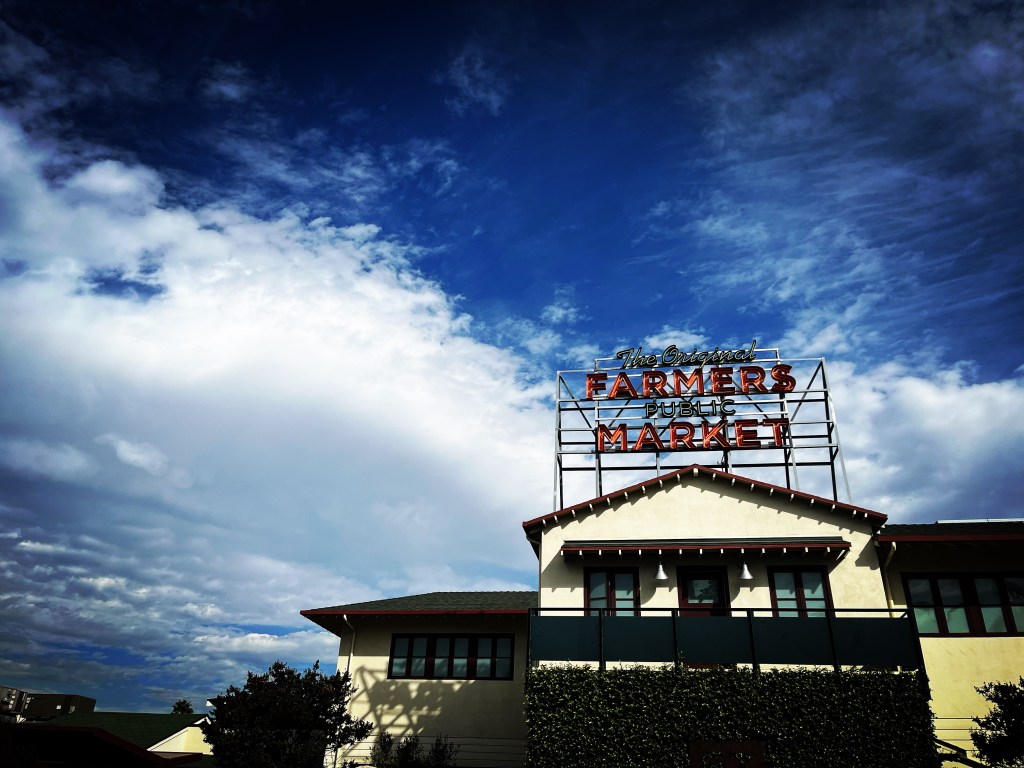
If you’ve never been to the Original Farmer’s Market, imagine it as a Mecca of street food purveyance, where upwards of 100 food vendors peddle all manner of deliciousness to hungry visitors like me. The market was established in 1890 to sell produce to local residents. Today, it’s like the souk of Marrakech, an open-air culinary destination crowded with food stalls hawking cuisine from the world over. There’s Pampas Grill, for Brazilian in stall 618, for example. There’s Moishe’s for Mediterranean in stall 336. And in stall 488 is Patsy D’Amore’s Pizza if you’re craving New York-style pie.
Tasty as all that seemed, these were the same foods I encounter everywhere I go. Like the Brazilian feijoada I’d eaten days before in Philly. Like the selfsame Israeli couscous I’d consumed the previous week in Miami. Like the almost-identical New York slice I had just experienced in, well, mid-town Manhattan. None of these would work. No, for my one, civilian meal in Los Angeles, I desired something wholly new to me: the culinary zeitgeist of L.A. amalgamated in a single dish.
So on I searched. I walked the aisles and alleyways of the Original Farmer’s Market for the next half-hour, finding delicious-looking crepe places, and an equally piquant-looking Cajun joint. But still I found nothing that compelled me to eat.
And then it happened: paydirt. I found what I was looking for. In stall 122, I discovered the magnificent Singapore’s Banana Leaf.
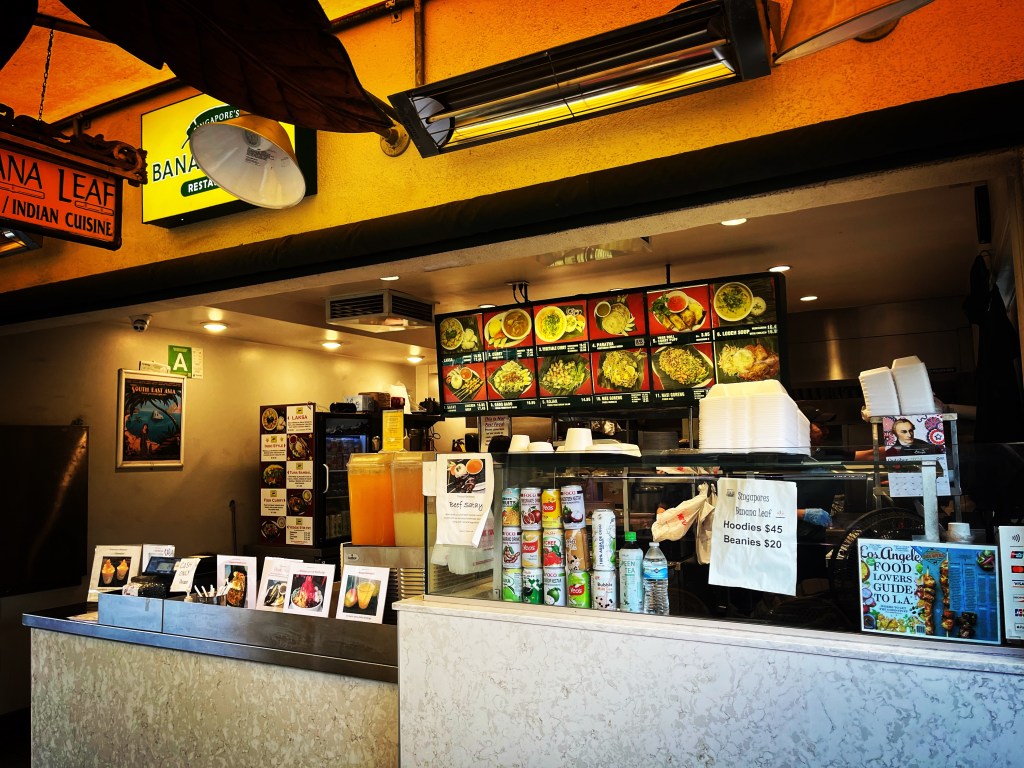
Billing itself as a purveyor of Singapore-style/Malay/Indonesian/Indian cuisine, Singapore’s Banana Leaf is the culinary lovechild of Singapore natives, Isaac and Diana Gazal. One look at their carefully curated menu reveals just how much the Gazal’s revere their native cuisine. There was Mee Goreng (pan-fried wheat noodles) and Nasi Goreng (pan-fried veggies and rice) and Gado Gado (cabbage salad with peanut sauce). But what I really wanted—and what my new friends at Singapore’s Banana Leaf were only too happy to serve me—was a bowl of their famously delicious Laksa soup.
The thing to know about Laksa is this: it’s a dish that succeeds on subtlety. In a food world now dominated by, say, ramen flavors turned up to a cacophonous “11” on the Marshall stacks of heavy metal-like savor, Laksa is a sonata, played pianissimo on a Steinway, on a lazy, breezy, summer afternoon. Its flavors speak to each other in whispers and susurrations, and with all the giggling echolalia of children running at twilight in a murmuration of play.
Laksa is widely believed to have originated in the 15th century, an offshoot from the culinary cross pollination of Singaporean Malays and the Peranakan Chinese, whose migration to the region inspirited interethnic marriages, as well as the marriage of two magnificent cuisines.
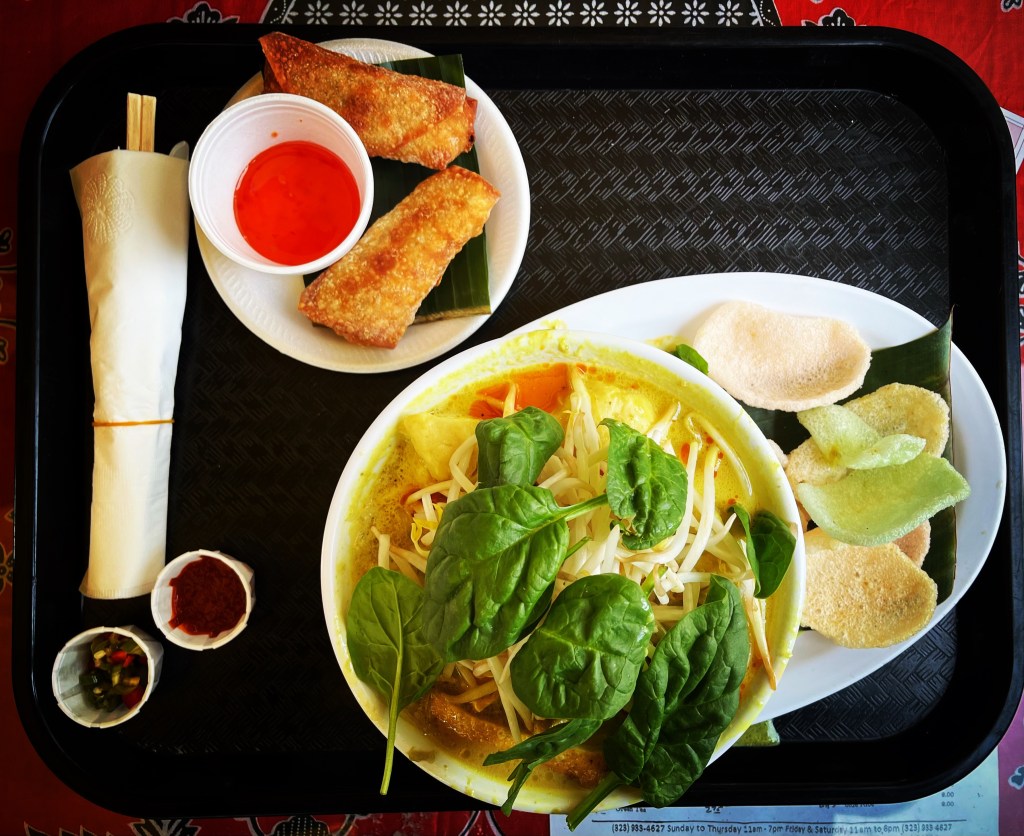
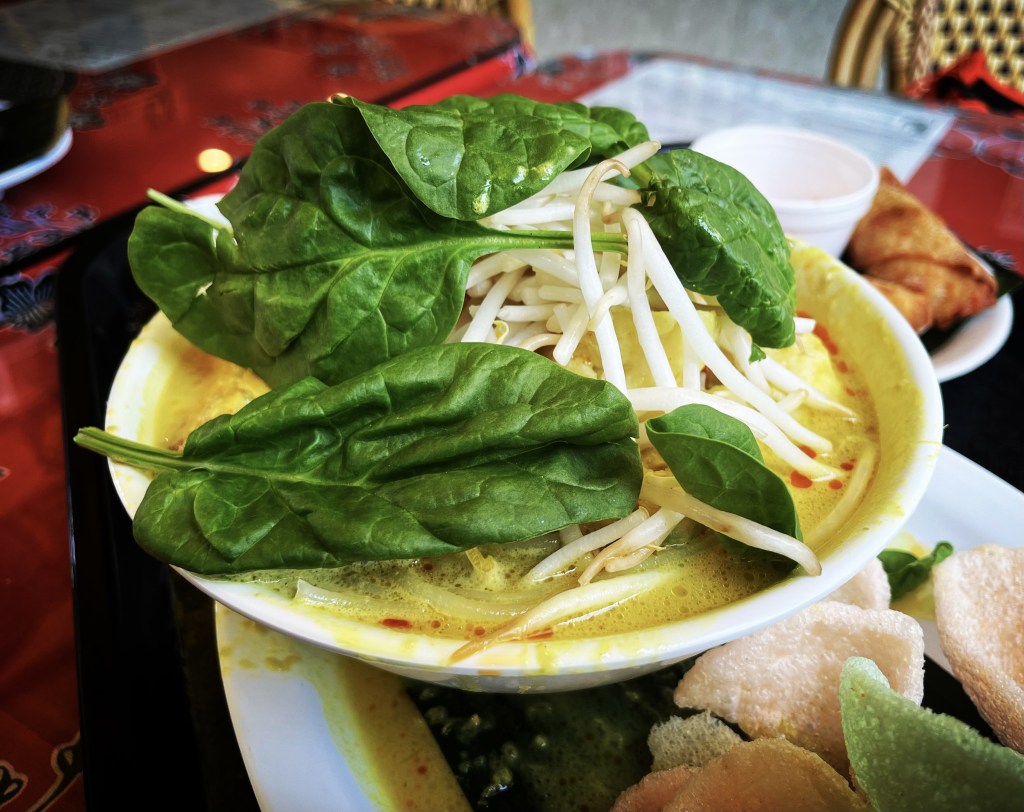
Looking into my bowl of Laksa, I could, indeed, see the union of food cultures. For in that glorious lake of coconut milk and curry (decidedly Malay touches) floated rice noodles, gifts from the Chinese. In there, too, was tofu, bean sprouts, fish cake made from cod, all of it topped with spinach leaves, all of it dancing together, in muted minuet and perfect equipoise of Singaporean sapidity and Chinese zest. So subtle was the interplay of flavors in my Laksa that I felt compelled to lean over my bowl and breathe it in, inhale deeply this aroma of absolute nuance in a dish. After a few, huffing breaths, I raised my head and ate again, the savor of soup alighting on my palate with a buoyancy of remarkable delicacy, as if borne up by butterfly wings.
This was a revelation, this bowl of gustatory hush that could so enliven my senses. Call it Laksa as the thaumaturgy of gustatory triumph. Call it Laksa as gastronomic lightening across a bright, blue sky. It was like Rutherford splitting the atom, this Laksa. It was like Oppenheimer building the bomb, with something so unimaginably mighty conjured out of seeming nothingness.
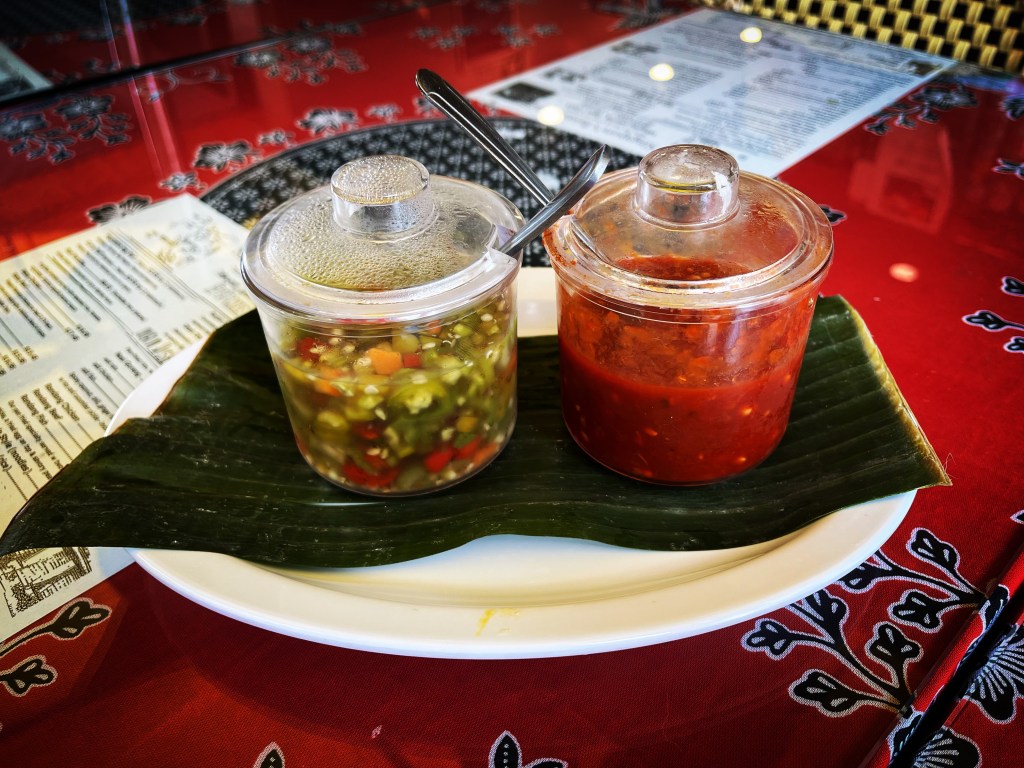
To discover that the good cooks of Banana Leaf could coax so much flavor from ingredients so undeniably pedestrian was an astonishing thing to behold. And though I knew that such absolute balance in a dish comes from centuries of continuous refinement, what I tasted in their Laksa seemed entirely…new, a dish for modern Angelinos that nods to the past while charting the course for the culinary Los Angeles of tomorrow.
At Singapore’s Banana Leaf, at the bottom of a soup bowl, I had finally found what I was looking for.
And I was hungry no more.
Contact: christopher@proletariateats.com


Leave a Reply